The crypto user base is heading from roughly 600 million in 2026 toward 1.2 billion by 2035, but the channels that grew exchanges in the last cycle are throttled, expensive, or compliance-restricted. This is the full-funnel playbook for acquiring, activating, and retaining funded traders in 2026 — trust signals, AI-search visibility, paid acquisition across restricted channels, community loops, and measurement that survives an audit.
Why Crypto Exchange Growth Broke the Old Marketing Playbook
The market is not the constraint. Global crypto users are projected to climb from roughly 600 million in 2026 toward 1.2 billion by 2035, and the exchange market is growing 12 to 15 percent a year. Demand is expanding. What changed is how you are allowed to capture it, and how much it costs.
The tactics that scaled exchanges in the last cycle — aggressive influencer pushes, return-led creative, untracked affiliate floods — are now throttled by ad-network policy, expensive because every competitor is bidding the same auctions, or actively damaging because trust has become the deciding factor in conversion. In 2026 the highest-converting traffic for many crypto products no longer comes from Google or paid social at all; it increasingly comes from users asking an AI assistant which exchange to trust.
This guide is the pillar. Each section links to a deeper playbook on the specific mechanic — funnel design, paid acquisition, CAC control, community, conversion, and measurement — so you can move from strategy to execution without losing the thread.
Start With the Funnel, Not the Channel
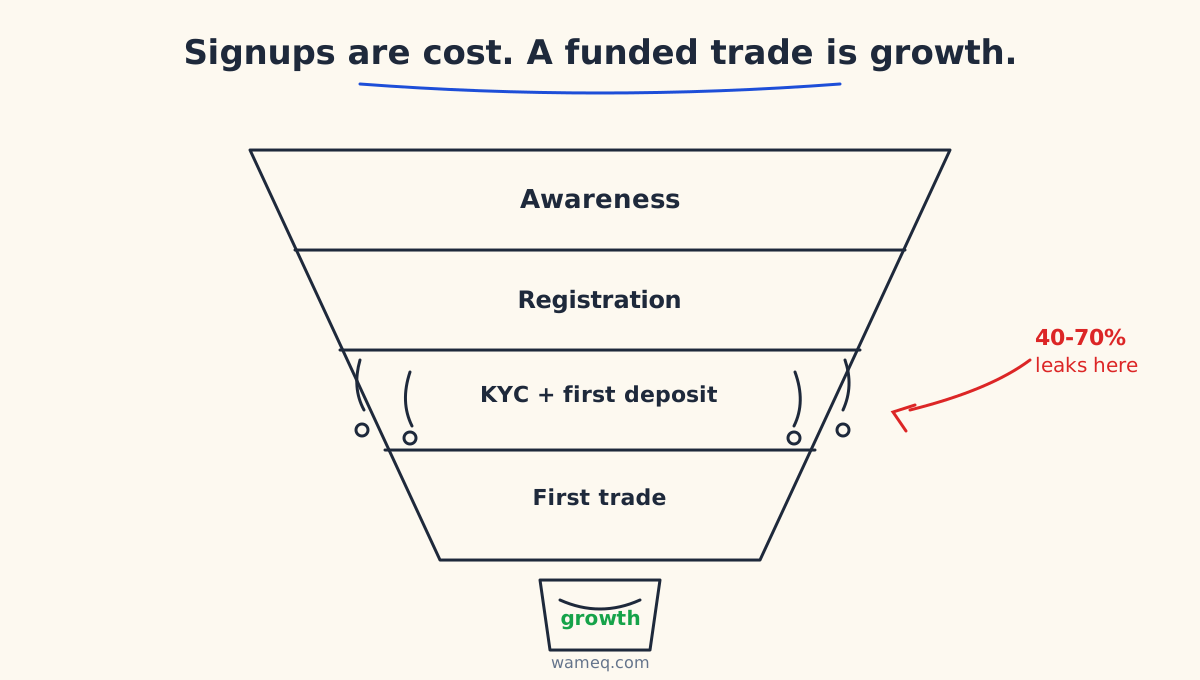
The most expensive mistake exchange marketing teams make is buying channels before defining the funnel. A signup is not growth. A funded account that places a first trade is growth. Everything upstream of that event is cost, and everything you optimise toward should be that event — not registrations, not app installs, not email captures.
Before you spend a dirham on acquisition, the funnel needs four defined stages and a measurable conversion rate between each: awareness, registration, KYC and first deposit, and first trade. The brutal economics of exchange marketing live in the KYC-to-funded gap, where 40 to 70 percent of registrations commonly evaporate. A channel that looks cheap on cost per signup is often the most expensive channel on cost per funded trader.
The full structure — how to map each stage, which metric gates each transition, and how to stop paying for registrations that never fund — is laid out in how to build a crypto marketing funnel that actually converts. Build that first. Everything below assumes it exists.
Want this implemented for your funnel?
Get a free 90-day growth plan with tracking, channel priorities, and next-week actions.
Trust Is the Conversion Layer in 2026
Crypto marketing has inverted. It used to be about promising upside; it is now about removing doubt. Users have lived through enough exchange collapses that the question in their head is not "how much can I make" but "will my money still be here next week". The page that answers that question converts. The page that ignores it does not, no matter how good the offer.
The trust signals that move conversion rate, roughly in order of impact:
- Proof of reserves and third-party audits: a live, verifiable reserves attestation is the strongest single conversion asset an exchange can publish in 2026.
- Regulatory licences and jurisdictions: stated plainly, per region, not buried in a footer.
- Security architecture: custody model, cold storage ratio, insurance, and incident history described in language a non-engineer can verify.
- Fee transparency: the full fee schedule visible before signup, not discovered after the first trade.
- Real proof, not stock claims: named team, verifiable track record, and concrete numbers instead of "award-winning" filler.
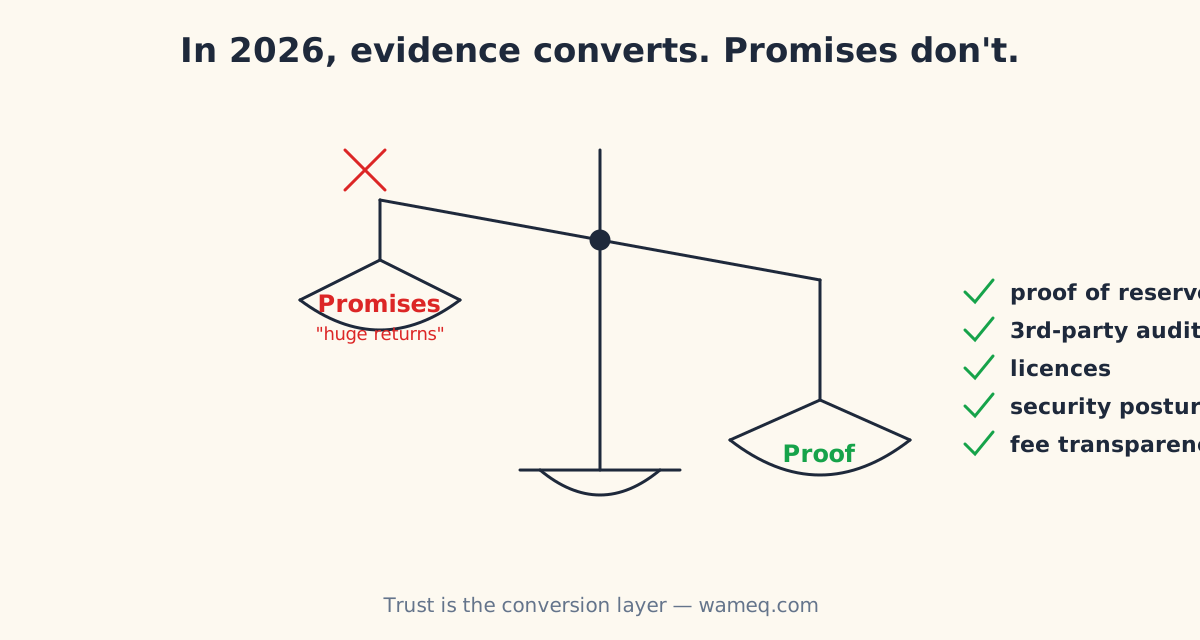
Treat these as conversion infrastructure, not a compliance afterthought. The mechanics of turning trust into measurable conversion lift — where to place proof blocks, how to test them, and how to read the behavioural signals that tell you which doubts are killing signups — are covered in the CRO guide for 2026 and in how user behaviour tells you what to fix.
Win the Organic and AI-Search Layer
When a prospective trader asks ChatGPT, Gemini, or Google's AI Mode "which crypto exchange is safest for beginners", one of two things happens: your exchange is named with its proof points, or it is invisible while a competitor is recommended. There is no paid shortcut to that placement. It is earned through topical authority and distribution, and it has become one of the highest-converting acquisition layers in crypto because the user arrives pre-qualified by a source they trust.
The organic layer for an exchange has three jobs:
- Be the answer in AI Overviews and AI assistants. Lead with extractable, evidence-backed answers to the safety, fee, and how-to questions buyers actually ask. The tactical approach is in how to rank in Google AI Overviews and what AIO and GEO actually mean and how to implement them.
- Win the click that still happens. A large share of search now resolves without a click, so the queries that do drive visits need stronger information scent and proof above the fold. The framing is in zero-click SEO: how to win when users do not click.
- Build a content hub that compounds. Security education, KYC walkthroughs, deposit and withdrawal guides, and market explainers form a topical cluster that signals authority to both search engines and language models. The architecture is in how to build a high-converting SEO strategy in 2026.
More than 45 percent of US crypto marketing budgets now go to educational content for exactly this reason: it is the only asset that simultaneously earns AI citations, ranks, and converts skeptical users. Distributing that content through digital PR to tier-one crypto outlets multiplies the citation effect well beyond self-publishing alone.
Paid Acquisition Across Restricted Channels
Paid still works for exchanges, but only inside the channels and formats that tolerate the category, and only with claims discipline. The reliable surfaces in 2026:
- App campaigns. For an exchange with a mobile app, Google App Campaigns are the workhorse — app-store intent is high and the format is compliance-tolerant. The full structure, creative requirements, and bidding approach for a crypto app are in the Google App Campaigns playbook for crypto apps.
- Apple Search Ads. The single highest-intent paid surface for app installs — users are searching the App Store with explicit intent. Subtitle and keyword strategy specific to this channel is in the Apple Search Ads guide for app marketers.
- Branded and competitor search. Defend your brand terms and capture competitor demand. Low CPC, high intent, and policy-safe because you are answering existing demand rather than creating financial expectations.
- Paid social for awareness. TikTok can build top-of-funnel awareness in permitted regions but demands high creative volume and a hard claims filter. The creative and structural approach is in how to run TikTok Ads in 2026.
Across every one of these, run a claims matrix: every headline maps to an approved evidence source, and nothing reaches an ad account without compliance sign-off. This is not bureaucracy — a single rejected account or policy strike can remove a channel for months.
CAC Discipline When AI Runs the Auction
Here is the structural problem with exchange paid media in 2026: the inputs you used to control — keywords, match types, bids, placements — are now owned by Performance Max, AI Max, and Smart Bidding. You hand the algorithm a budget and a conversion goal, and it optimises against whatever you told it to value. If you tell it to value signups, it will find you the cheapest signups in the world, and almost none of them will fund an account.
Two disciplines keep CAC honest:
- Structure the account for control you still have. Funnel-stage separation, clean conversion signals, and a deliberate bidding progression are still yours to set. The full architecture is in Google Ads CAC control: the full-funnel structure that scales.
- Measure incrementally, not by what the platform reports. Replace reported ROAS with contribution margin per funded trader, run a geo holdout test each quarter, and track blended CAC across every channel. The reported-versus-incremental gap is routinely 2x to 4x. The measurement stack is in how to measure PPC performance when AI controls the auction.
The single most important instruction you give the AI is the conversion you optimise toward. Feed it funded accounts with their deposit value as conversion value, imported from your backend — not registration events. Get that wrong and every layer above it optimises toward the wrong trader.
Community Is the Crypto Growth Multiplier
Every channel discussed so far has a rising or flat cost curve. Community is the only one whose cost per new trader falls over time, because it converts your existing funded users into the acquisition mechanism. In a category where trust is signalled by peers, this is not a nice-to-have — it is the structural advantage that separates exchanges that scale profitably from those that buy growth until the budget runs out.
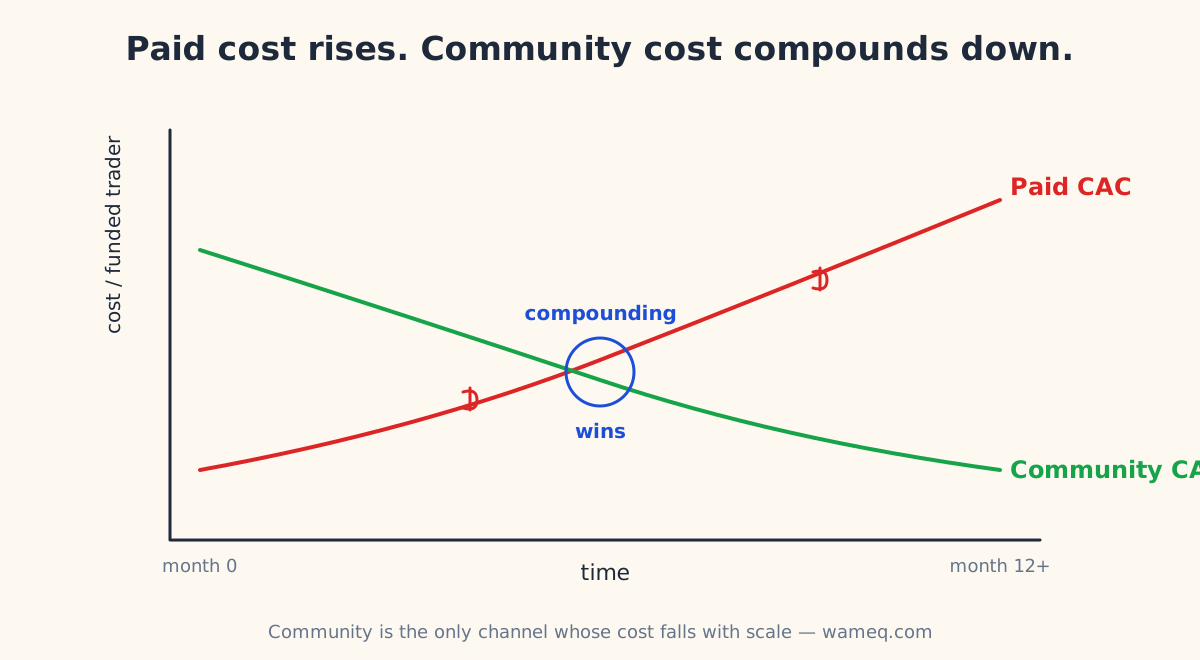
The components that compound:
- A moderated home base. Discord for structured discussion, Telegram for rapid announcements, both actively moderated. Unmoderated channels destroy trust faster than ads can build it.
- A referral loop tied to funded activity. Reward the funded deposit or first trade of the referred user, not the signup, so the loop cannot be farmed.
- KOL partnerships with mid-tier creators. Engaged trading audiences with tracked referral codes outperform celebrity reach on a cost-per-funded-trader basis.
- Recurring rituals. AMAs, trading competitions, and education series that give the community a reason to return and a reason to bring others.
The operating model — how community functions as growth infrastructure rather than a support cost — is in what community-led growth is and why it matters.
Activation and Onboarding: Where Most Exchange Budgets Leak
You can win every section above and still lose, because the largest single leak in exchange economics is between registration and first funded trade. KYC friction, unclear deposit paths, wallet-connection confusion, and an empty-state dashboard with no obvious next action quietly waste the entire acquisition spend that delivered the user.
Treat onboarding as a conversion surface with the same rigour as a landing page. Set explicit KYC expectations before signup so verification is not a surprise, instrument every step of the funded-account flow, watch session recordings of drop-off points, and remove one friction point per cycle based on evidence rather than opinion. The systematic approach is in the CRO guide, and the behavioural diagnostic — reading heatmaps and recordings to find the real reason users stall — is in how user behaviour tells you to improve your website.
Measurement That Survives an Audit
Every decision above depends on data that holds up under scrutiny. Most exchange analytics setups cannot answer the only question that matters — what did it cost to acquire a funded trader, by channel — because they track registrations client-side and never reconcile them against backend funding events.
The measurement foundation for an exchange:
- A conversion model built on funded activity. Mark the funded account and first trade as primary conversions, pass deposit value as conversion value, and import these from your backend so ad platforms optimise toward revenue, not registrations. The implementation is in how to track conversions in GA4 step by step.
- A property configured for production scrutiny. Correct event taxonomy, Consent Mode for restricted regions, server-side tagging to survive ad blockers, and cross-domain tracking if onboarding spans subdomains — covered in the GA4 setup guide for 2026.
- An attribution model you can defend. Last-click flatters whatever channel sits closest to the funded event and starves the community and content layers that actually drive trust. The alternative is in marketing attribution in 2026.
If the foundation is wrong, every section of this playbook optimises toward the wrong outcome with full confidence. Fix measurement before you scale spend, not after.
The First 90 Days: How to Sequence This
The order matters more than the list. Attempting all of it at once is how exchange marketing budgets disappear without a defensible result.
- Weeks 1 to 3 — measurement and funnel. Define the funded-account conversion, fix tracking, and map the four funnel stages with current conversion rates. You cannot improve what you cannot see.
- Weeks 3 to 6 — trust and onboarding. Ship the proof assets and remove the highest-impact friction in the KYC-to-funded flow. This raises the return on every acquisition dirham you are about to spend.
- Weeks 5 to 9 — paid and community in parallel. Launch app campaigns and branded search with CAC controls, and stand up the moderated community and referral loop at the same time so the compounding channel starts early.
- Weeks 8 to 12 — organic and AI-search. Begin the educational content hub and digital PR. It is the slowest channel to pay off and the most durable, so it has to start before you need it.
If you want this built and operated as one system rather than a set of disconnected tactics, that is the work I do — see paid media and analytics and CRO, or get in touch with your current funnel numbers and we will start from where the spend is actually leaking.
Get weekly growth ideas in your inbox
Practical SEO, PPC, analytics, and CRO notes with zero spam.
Frequently Asked Questions
What is the single most important metric for crypto exchange growth?▾
Which paid channels still work for a crypto exchange in 2026?▾
How do you market a crypto exchange without making prohibited financial promises?▾
Why is community more important for exchanges than for most businesses?▾

Digital marketing consultant — SEO, PPC, analytics & CRO.