A practical guide to improving your chances of being surfaced in Google AI Overviews by focusing on intent match, structure, authority, and source-worthy content.
First: you do not “rank” in AI Overviews the same way you rank in blue links
That framing matters. A lot of people are treating Google AI Overviews as if they are a separate SEO channel with a hidden checklist. They are not. AI Overviews are a Google Search feature that synthesizes information from multiple sources and presents an answer before the user clicks.
So the real objective is not to hack your way into a box. It is to become one of the pages Google is comfortable using when it builds that answer.
That means the pages with the best chance are usually the ones that already do four things well:
- match the search intent clearly
- answer quickly and specifically
- show strong topical and author credibility
- make the information easy to extract and trust
Google has already said AI Overviews are being shown more often for harder questions, including more complex and multimodal queries. In 2025 and 2026, Google also expanded AI search behavior through AI Mode and upgraded AI Overviews with newer Gemini models. That tells you the direction of travel: search is getting more answer-led, more conversational, and more synthesis-heavy.
What Google is signaling right now
Google's own product updates are the clearest source here. In March 2025, Google said AI Overviews were expanding and being shown more often for harder questions. In January 2026, Google described a more seamless answer experience with follow-up capability built directly into Search. That matters because it changes the kinds of pages likely to earn value from search.
The pages that benefit most are not the ones with the loosest topical relevance. They are the ones that help Google answer layered questions cleanly.
Inference from Google's updates: if Search is moving toward more complex, follow-up-heavy answers, then shallow content built for one exact-match keyword becomes less competitive than pages that handle the core question, the supporting sub-questions, and the practical next step in one coherent structure.
Sources: Google: Expanding AI Overviews and introducing AI Mode, Google: AI Mode in Google Search and AI Overviews get Gemini upgrades
Want this implemented for your funnel?
Get a free 90-day growth plan with tracking, channel priorities, and next-week actions.
What content is most likely to be used in AI Overviews?
No one outside Google has a complete formula, and anyone pretending otherwise is selling certainty they do not have. But the pattern is already visible.
Pages are more useful to AI Overviews when they:
- answer a specific question directly rather than taking 600 words to get to the point
- use strong heading structure so the answer is broken into extractable parts
- cover supporting context such as definitions, steps, examples, and caveats
- show evidence of expertise through experience, examples, author clarity, and coherent site context
- fit into a broader topic system rather than existing as an isolated post with no internal support
This is one reason I keep pushing pillar-and-cluster architecture. A page is easier for Google to trust when it sits inside a site that clearly knows the topic, not when it looks like a one-off article published to chase a trend.
Step 1: target the kind of query AI Overviews actually appear for
Not every keyword deserves the same strategy. AI Overviews tend to matter more for informational and exploratory queries than for direct branded navigation. If the query is broad, ambiguous, or multi-step, the AI layer becomes more likely to intervene.
That means good target opportunities often look like:
- how-to queries: "how to rank in google ai overviews"
- comparison or evaluation queries: "seo vs google ads for saas"
- definition + implementation queries: "what is topical authority and how to build it"
- multi-part informational queries: questions where users need explanation plus action
If your page only targets a head term without helping the user complete the thought behind it, the AI layer has more reason to synthesize other sources instead.
Step 2: write for answerability, not fluff
This is where most teams lose. They write introductions like they are trying to warm up a keynote. AI systems are far less patient than human readers. If the page does not state the answer clearly and early, it is less useful as source material.
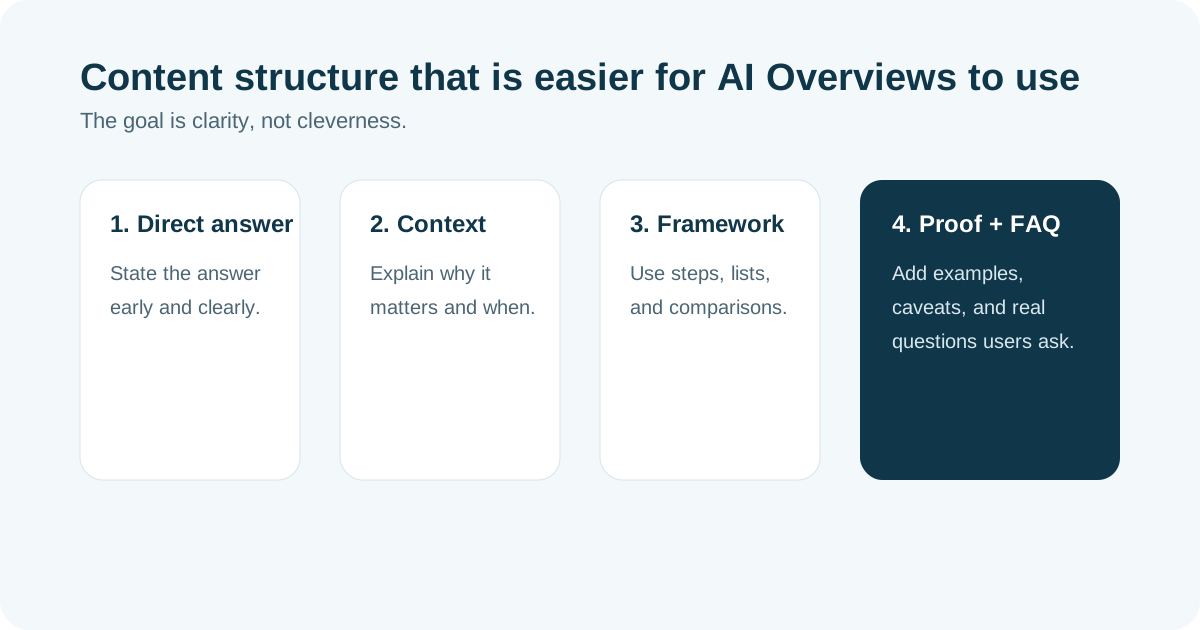
A strong article structure usually looks like this:
- direct answer in the opening section
- clear explanation of why it matters
- step-by-step implementation or framework
- examples, edge cases, and practical mistakes
- FAQ-style questions that match real search behavior
That does not mean writing like a machine. It means writing like someone who respects the reader's time.
Step 3: make the page easy to extract
AI Overviews are built from information that can be interpreted quickly. Pages with weak structure create more work. Pages with clear structure reduce ambiguity.
Useful formatting patterns:
- descriptive
h2headings that reflect real sub-questions - short paragraphs instead of long walls of text
- ordered lists for processes
- bullet lists for comparisons or signals
- FAQ sections where they genuinely help
This is also where schema can help. Not because schema is magic, but because it gives machines a cleaner understanding of page type and support content. For glossary pages, FAQ blocks, articles, and clearly structured service pages, that context helps.
Step 4: build real topic authority around the page
A single article rarely wins this alone. Google is more likely to trust your page on AI Overviews if your site repeatedly demonstrates competence on adjacent parts of the same topic.
For example, if you want this article to perform, it should be supported by related content like:
- What is AIO and GEO and how to implement it
- What is a good CTR for SEO
- a future article on zero-click SEO
- a future article on measuring SEO when AI search reduces clicks
That support structure tells Google your site is not just mentioning AI search once. It is building an informed topic system around it.
Step 5: strengthen trust signals and entity clarity
Google does not need your site to look corporate. It does need it to look real, specific, and credible. That matters even more when answers are synthesized.
At minimum, make sure the site has:
- a clear author or business identity
- an about page that explains expertise plainly
- supporting glossary terms and educational content
- service pages connected to the topic where relevant
- internal consistency in language, positioning, and claims
If your content sounds generic, cites nothing, and appears disconnected from the rest of the site, it is asking Google to trust a weak signal.
Step 6: optimize for click quality, not just visibility
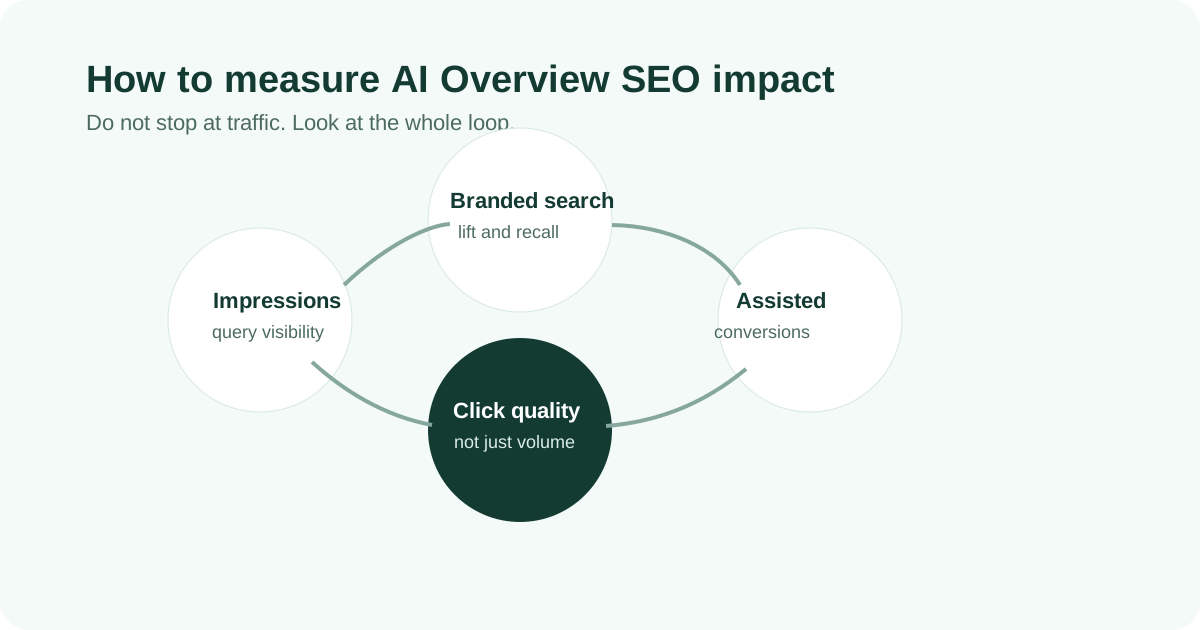
AI Overviews can change click behavior. Sometimes they reduce clicks. Sometimes they shift clicks toward users who are further along and want a deeper answer. That means you should stop evaluating success only through raw organic traffic.
Track instead:
- high-impression query growth in Search Console
- branded search lift after publishing topic-led content
- assisted conversions from informational SEO pages
- lead quality from organic traffic paths
- CTR by position and query type, not one blended average
This is the same reason I treat SEO measurement as part of an analytics problem, not just a rankings problem. If AI search changes the click path, your reporting has to evolve with it.
What usually stops pages from appearing in AI Overviews?
- Generic intros that delay the answer
- weak topic coverage with no supporting depth
- messy page structure that makes extraction harder
- no credibility signals around author or site expertise
- thin or repetitive content that says nothing new
- ranking with the wrong page because internal architecture is weak
In other words: the same fundamentals that hurt classic SEO often hurt AI Overview visibility too. The only difference is that synthesis makes weak content even easier to ignore.
A practical workflow you can use this week
- Pick one topic where you already have some authority or commercial relevance.
- Audit the current SERP and note whether AI Overviews appear for the query set.
- Rewrite the target page so the answer appears early and the structure is cleaner.
- Add supporting sections for implementation, examples, and FAQs.
- Improve internal linking from related articles, glossary terms, and service pages.
- Track query impressions and click quality in Search Console and GA4 rather than waiting only for rankings.
That is boring advice, but it is the kind that tends to work.
The short truth
If you want to rank in Google AI Overviews, create pages that are easier to trust and easier to use than the alternatives. Be clearer. Be more specific. Structure the answer properly. Support the topic with related content. And measure success with more maturity than raw traffic alone.
That is the strategy. Not a loophole.
If you want help turning your existing content into an AI-search-ready topic cluster, get in touch.
Get weekly growth ideas in your inbox
Practical SEO, PPC, analytics, and CRO notes with zero spam.
Frequently Asked Questions
Can you optimize directly for Google AI Overviews?▾
Do AI Overviews reduce clicks?▾
What kind of content appears in AI Overviews most often?▾
Does schema help with AI Overviews?▾
How should I measure SEO if AI Overviews change CTR?▾

Digital marketing consultant — SEO, PPC, analytics & CRO.