Getting more traffic is expensive. Converting the traffic you already have is the highest-ROI activity in digital marketing. Here is the systematic CRO framework we use with clients.
The Most Overlooked Growth Lever in Digital Marketing
If your website converts at 2% and you run £10,000 in ads this month, you generate roughly 200 leads. If you improve conversion rate to 4%, with the same budget and same traffic, you generate 400 leads. That is the compounding power of CRO. It makes every other marketing channel more efficient simultaneously.
Yet most businesses treat conversion optimisation as an afterthought, something to revisit once they have "enough" traffic. The reality is that CRO insights become the strongest input for messaging strategy, ad creative, landing page design, and even product positioning. It should be running continuously, not episodically.
This guide covers the systematic approach we use to identify, prioritise, and test conversion improvements that compound over time.
The CRO Research Phase: Finding What Is Broken
Every effective CRO programme starts with research, not testing. Testing without research is guessing. The research phase answers one question: where and why are users not converting?
The research toolkit we use:
- Funnel analysis in GA4: identify where the largest drop-offs occur between steps in your conversion funnel. The biggest drop is your first priority.
- Heatmaps: Hotjar or Microsoft Clarity reveal which page elements users interact with and which they ignore. Common findings: CTAs below the fold are rarely clicked, hero sections are scanned not read, and trust signals are often missed.
- Session recordings: watch real users navigate your site. Look for rage clicks, confusion patterns, and early exits. This is uncomfortable to watch and always revealing.
- User surveys: on-page surveys asking "What stopped you from signing up today?" or "What information were you looking for?" generate the exact language your buyers use to describe their hesitation.
- Sales call analysis: your sales team hears the same objections repeatedly. These objections should be proactively addressed on your landing pages.
Want this implemented for your funnel?
Get a free 90-day growth plan with tracking, channel priorities, and next-week actions.
The LIFT Model: Diagnosing Conversion Problems
The LIFT model (developed by Widerfunnel) provides a structured way to evaluate any landing page or conversion flow. It identifies six factors that drive or kill conversions:
- Value proposition: is it immediately clear what you offer, who it is for, and why it is better? This is the most important factor and the most commonly weak.
- Relevance: does the page match the expectation set by the ad or link that brought the user there? Message match between ad and landing page has an enormous impact on conversion rate.
- Clarity: is the page easy to understand and the next step obvious? Cognitive load kills conversions.
- Anxiety: what concerns does the user have about taking action? Privacy worries, risk of commitment, uncertainty about fit.
- Distraction: are there elements on the page competing with your primary CTA? Navigation menus, exit links, and competing offers all reduce conversion rate on dedicated landing pages.
- Urgency: is there a compelling reason to act now rather than later? Time-limited offers, scarcity signals, or pain-point urgency.
Use this framework to score your landing pages and generate hypotheses for testing. The factor with the lowest score gets your first test.
Writing Hypotheses That Lead to Learning
Every A/B test should start with a hypothesis in this format: "Because [research insight], we believe that changing [specific element] to [new version] will [measurable outcome] for [specific audience]."
A good hypothesis is falsifiable: you will know definitively if it was right or wrong. It is grounded in observed user behaviour rather than aesthetic preference. And it tests one variable at a time so results are attributable.
Bad hypothesis: "We think the headline is not engaging enough, so we will try a new one." Good hypothesis: "Because session recordings show 60% of users scroll past the hero without clicking, and our user survey identified 'unsure if it works for my industry' as the top hesitation, we believe adding a customer logo strip below the hero will increase hero-to-signup clicks by 15%."
Prioritising Tests With the PIE Framework
You will always have more test ideas than capacity to run them. The PIE framework helps prioritise: score each test idea on Potential (how much improvement is possible?), Importance (how much traffic and revenue does this page/step affect?), and Ease (how difficult is this to implement?).
Score each on a 1-10 scale and average the scores. Run the highest-scoring tests first. This ensures you focus effort where it can have the greatest business impact, rather than running tests on low-traffic pages that will never reach statistical significance.
Running Tests That Produce Valid Results
Most A/B tests are run incorrectly. The most common mistakes are stopping tests early when results look promising, running multiple simultaneous tests that interfere with each other, and declaring winners based on insufficient sample sizes.
Best practice for valid A/B testing:
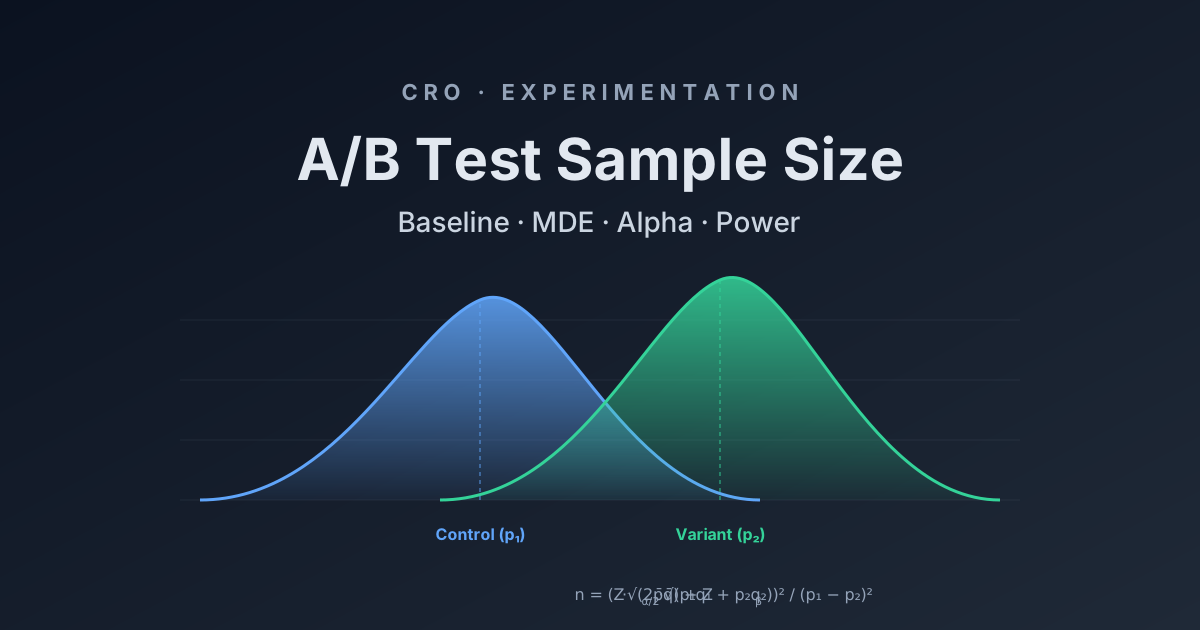
- Calculate required sample size before starting, using a significance calculator with 95% confidence and 80% statistical power
- Run tests for at least two full business cycles (typically two weeks minimum) to account for day-of-week and time-of-day variation
- Test one element at a time in standard A/B tests; use multivariate testing only when you have very high traffic
- Primary metric must be your conversion event, not a proxy metric like click-through rate
The Highest-Impact CRO Changes
Based on our testing across dozens of accounts, these consistently deliver the largest conversion lifts:
- Headline rewrite: shifting from feature-focused to outcome-focused headlines ("AI-powered analytics" → "Know exactly which campaigns are driving revenue") typically lifts conversion 15-40%
- Form length reduction: every field you remove increases completion rate. Ask only for what you need to have a conversation.
- Social proof placement: moving testimonials and logos above the fold rather than at the bottom of the page
- CTA copy specificity: "Get my free audit" outperforms "Submit" or "Get started" consistently
- Page speed: a 1-second improvement in load time improves conversion rate by 7% on average
Get weekly growth ideas in your inbox
Practical SEO, PPC, analytics, and CRO notes with zero spam.
Frequently Asked Questions
What is a good conversion rate for a B2B website?▾
How much traffic do I need to run A/B tests?▾
Should I use Optimizely, VWO, or another tool for A/B testing?▾
Is CRO only about landing pages?▾

Digital marketing consultant — SEO, PPC, analytics & CRO.