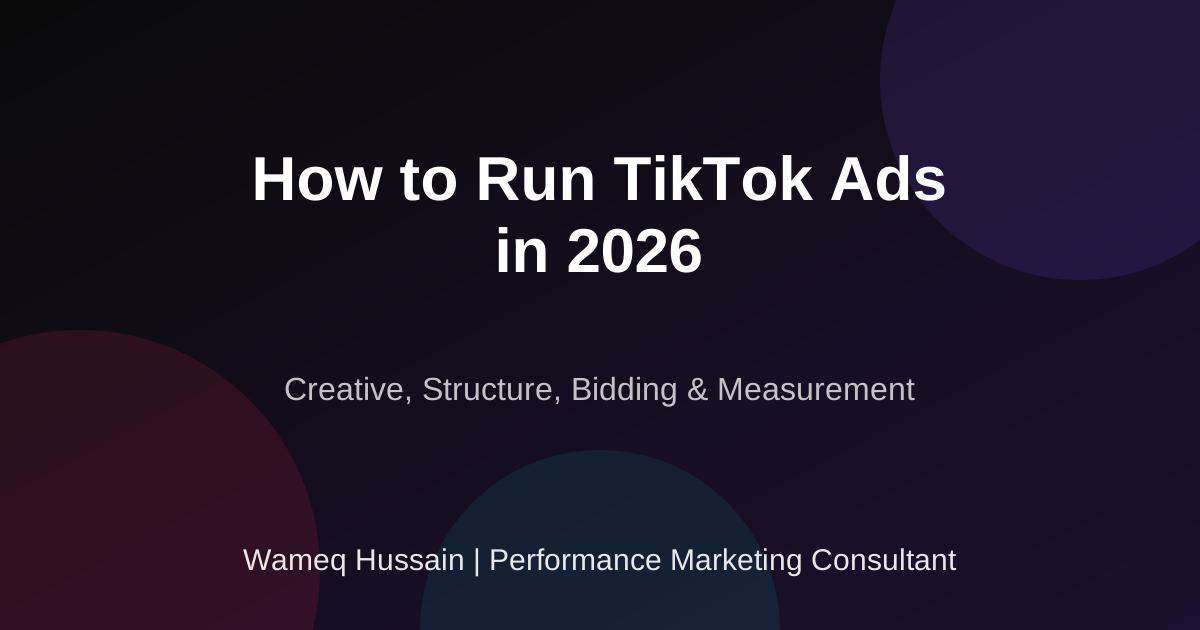
TikTok ads have matured into a serious performance channel — but most advertisers still treat it like Instagram with a vertical video. This guide covers account structure, creative strategy, bidding, and measurement the right way.
Why TikTok Ads Deserve a Serious Look in 2026
Two years ago, TikTok ads were an experiment. Today they are a core budget line for D2C brands, mobile apps, SaaS tools, and even B2B advertisers who have figured out how to make the format work. The platform has over 1.5 billion monthly active users globally, an algorithm that is genuinely better at matching content to intent than any other social platform, and an ads ecosystem that has matured significantly since the early days of poorly optimised campaign types and limited attribution.
But most advertisers still approach TikTok the wrong way. They take a Facebook ad, make it vertical, run it on TikTok, and wonder why it does not convert. TikTok is a fundamentally different platform with a different content grammar, a different user psychology, and a different relationship between creative and performance. Getting it right requires understanding those differences, not just reformatting your existing assets.
This guide covers how to actually run TikTok ads profitably in 2026 — account setup, campaign structure, creative strategy, bidding, measurement, and scaling.
Step 1 — Set Up Your TikTok Ads Account Correctly
Before you spend a dollar, get your tracking infrastructure right. Retrofitting tracking after you have already spent budget is one of the most expensive mistakes in paid media.
TikTok Pixel + Events API
Go to TikTok Ads Manager and navigate to Assets → Events → Web Events. Install both the TikTok Pixel (browser-side) and the Events API (server-side). The combination of both is what TikTok calls "Dual Signal" and it is essential for accurate measurement under iOS restrictions.
Set up your event sequence in priority order: PageView → ViewContent → AddToCart → InitiateCheckout → Purchase. Include purchase value and currency on the Purchase event. Without value data, the algorithm cannot optimise for revenue — only for purchase count.
Business Centre vs Direct Advertiser Account
If you are managing ads for a brand (rather than your own business), set up a TikTok Business Centre account and link your Ad Account and TikTok organic account to it. This keeps assets centralised, enables Spark Ads (boosting organic posts as paid ads), and makes agency/client handover clean.
Connect your TikTok organic account
Link your brand's TikTok profile to your Ads Manager. This unlocks Spark Ads, which let you run organic posts as paid ads — complete with real likes, comments, and shares. Spark Ads consistently outperform standard In-Feed creative by 20–40% in our experience because they look native and carry social proof.
Want this implemented for your funnel?
Get a free 90-day growth plan with tracking, channel priorities, and next-week actions.
Step 2 — Understand the Campaign Structure
TikTok Ads Manager uses a three-level structure: Campaign → Ad Group → Ad. Each level controls different things.
Campaign level
Set your campaign objective here. For most direct-response advertisers, the right objective is Website Conversions (optimising for purchases or leads) or App Installs for mobile. Awareness and Traffic objectives are rarely the right choice for performance campaigns — they optimise for cheap impressions and clicks, not meaningful actions.
Campaign budget optimisation (CBO) lets TikTok distribute budget across ad groups automatically. Use it once you have multiple ad groups with proven performance. In the early testing phase, set budget at the ad group level so you can control spend per test.
Ad Group level
This is where you set targeting, placement, schedule, and bid strategy. Key decisions at this level:
- Placement: Start with TikTok only (not the broader Pangle network). The audience quality difference is significant.
- Targeting: Start broader than you think you should. TikTok's algorithm performs better with larger audience pools. For most campaigns, a custom audience or 1–2 interest layers is enough — avoid stacking 5+ interest categories.
- Schedule: Run ads 24/7 initially. Dayparting (restricting hours) limits the algorithm's ability to find conversions and rarely improves CPA until you have substantial data.
- Optimisation event: Choose the deepest conversion event that fires at least 20–30 times per week. If purchases are rare, optimise for AddToCart or InitiateCheckout while you scale up volume.
Ad level
Upload your creative here. Run 3–5 creative variants per ad group from day one. TikTok's algorithm will allocate spend to the best performer, but having multiple variants prevents premature creative fatigue from killing your campaigns.
Step 3 — Creative Strategy (This Is What Actually Determines Performance)
TikTok has a saying internally: "Don't make ads, make TikToks." It is overused but accurate. The single biggest predictor of TikTok ad performance is creative quality — not targeting precision, not bid strategy, not campaign structure. Creative is your targeting.
The 3-second hook rule
You have 1.5–3 seconds before a user scrolls. Your video must give them a reason to stop in that window. Strong hooks include: a bold on-screen text statement, a surprising visual, a relatable problem statement, or a direct address to the viewer ("If you [problem], watch this"). Weak hooks are logo reveals, brand names, or generic product shots.
Check your 2-second video retention rate in TikTok Analytics. Below 30% means your hook is losing people immediately. Above 50% means people are engaged and the algorithm rewards you with cheaper CPMs.
The native content formula
TikTok users are extremely sensitive to content that feels like an ad. The formats that perform best feel like content first and an ad second. The most reliable structures are:
- Problem → Agitation → Solution: Open with a pain point the target user recognises, make it feel real, then reveal the product as the answer. Keep the total runtime under 30 seconds.
- UGC-style testimonial: A real user (or creator) speaking directly to camera, sharing their genuine experience. No polish, no production value — authenticity is the point.
- Demonstration: Show the product doing something impressive or surprising. Works particularly well for physical products, food, beauty, and gadgets.
- Trending audio + product integration: Use a trending sound and find a natural way to integrate your product. Requires more creative judgment but can produce viral-scale results at paid media costs.
Creator partnerships and UGC
In 2026, the most cost-efficient creative source for TikTok ads is not your in-house team — it is creators. TikTok Creator Marketplace lets you find and brief creators in your niche. You do not need mega-influencers. Micro-creators with 10,000–100,000 followers typically produce better-performing ad creative than larger accounts because their content reads as more authentic.
Commission 5–10 UGC videos at a time, whitelist the best performers (get usage rights and run them as Spark Ads), and build a repeatable creative production pipeline rather than one-off campaigns.
Creative fatigue and refresh cadence
Winning TikTok ads typically start declining in performance within 7–14 days. This is faster than Meta and much faster than search. If you do not have a system for producing new creative regularly, you will constantly be chasing performance decay rather than scaling. Build a monthly creative calendar: brief, produce, test, scale, retire. Treat creative like a production process, not a one-time task.
This is the same principle that applies to conversion rate optimisation — systematic testing and iteration beats trying to find the perfect version on the first attempt.
I run TikTok ads for brands across fashion and lifestyle — and creative velocity is the single biggest lever I have found. For one activewear brand, doubling the creative refresh rate (from monthly to bi-weekly) was the move that took ROAS from 1.8x to 3.6x in eight weeks. Not a new audience. Not a new bid strategy. New creative, consistently. If you want that kind of result for your brand, let's talk.

Step 4 — Bidding and Budget Strategy
TikTok offers several bid strategies. The right choice depends on your campaign maturity and goals.
Lowest Cost (automatic bidding)
TikTok spends your budget to get the most conversion events at the lowest cost the algorithm can find. This is the right starting point for most campaigns. It gives the algorithm maximum flexibility and is best when you are learning what your real CPA looks like on the platform.
Cost Cap
You set a target CPA and TikTok tries to stay within it. This is more stable than Lowest Cost but can cause underspend if the cap is set too aggressively. Use Cost Cap once you have 2–3 weeks of conversion data and you know what a realistic CPA looks like.
Minimum ROAS
You set a minimum return on ad spend and TikTok only bids on impressions it believes will meet that threshold. Works well for ecommerce with reliable purchase value data. Requires strong conversion signal to function correctly — at least 50+ purchase events per week in the account.
Smart Performance Plus
TikTok's fully automated campaign type handles targeting, bidding, and creative combinations. It works well at scale when the algorithm has strong conversion signal. Without it, performance is inconsistent. Treat it as a scaling tool after you have proven your offer with manual campaigns, not a shortcut to skip the learning phase.
Step 5 — Targeting Without Over-Targeting
The most common targeting mistake on TikTok is the same one people make on Meta: over-targeting. Stacking 6 interest categories, 3 demographic filters, and 2 behavioural layers sounds precise but actually starves the algorithm of the audience size it needs to find conversions efficiently.
For cold audiences
Start broad. If your product is relevant to 18–35 year-olds in the US, run a campaign with just that age and geo filter and nothing else. Let TikTok's algorithm find the buyers within that pool. You will often find it outperforms heavily segmented targeting because the algorithm is optimising against a much larger signal set.
Custom audiences
Upload your customer list, website visitor data, or engagement audience to create custom audiences. Use these for retargeting campaigns with a different creative approach — warmer messaging, social proof, urgency — rather than running the same cold creative to warm audiences.
Lookalike audiences
TikTok's lookalike audiences work well when seeded from high-quality sources: purchasers, high-LTV customers, or engaged app users. Seed from your best 1,000–5,000 customers rather than all website visitors. A 1–3% lookalike is a good starting point — expand to 5–10% if volume is too limited.
Step 6 — Measurement and Attribution
TikTok attribution is one of the most misunderstood areas of the platform. The default attribution window (7-day click, 1-day view) inflates reported conversions significantly because view-through attribution credits TikTok for any purchase made within 24 hours of a video impression — even if the user never clicked.
Set the right attribution window
For direct-response campaigns, use 1-day click / 0-day view as your standard reporting window. It is more conservative and reflects conversions where TikTok had clear intent signal. Compare this to your actual revenue in your ecommerce platform or CRM — if TikTok-reported revenue is 3x your actual revenue growth, your attribution window is too generous.
Use TikTok alongside your own analytics
Never manage TikTok budgets based solely on in-platform reporting. Set up GA4 conversion tracking with proper UTM parameters on every TikTok ad URL so you can cross-reference platform data with independent session and conversion data. The gap between the two tells you how much view-through inflation is in your TikTok numbers.
Incrementality testing
If TikTok is a significant budget line, run a holdout test every quarter. Pause TikTok for a defined period in a matched geography or audience segment and measure the impact on total revenue. This tells you TikTok's true incremental contribution — something that platform attribution can never tell you accurately. Our guide on marketing attribution covers the full methodology for this.
Step 7 — TikTok Shop and Social Commerce Integration
In 2026, TikTok Shop is no longer just a feature — it is a serious sales channel for certain product categories. Fashion, beauty, food, and home goods brands are generating significant revenue through in-app checkout, and TikTok's algorithm actively promotes Shop-integrated content because it keeps users on-platform.
If your product is eligible for TikTok Shop, consider running a parallel track: standard in-feed ads driving to your website alongside Shop ads using TikTok's native checkout. Compare CPA across both. For some product categories, Shop converts at 30–50% lower CPA because friction is dramatically reduced — users never leave the app.
Be aware that TikTok Shop inventory management, customer service, and return policies are separate from your standard ecommerce operations. Factor that operational overhead into your decision before committing to the channel.
Step 8 — Scaling What Works
Scaling TikTok campaigns requires a different approach from scaling search campaigns. You cannot just increase budget and expect linear performance — the algorithm needs time to adjust, and creative fatigue accelerates at higher spend levels.
Budget scaling rules
Increase daily budget by no more than 20–30% at a time. Larger increases reset the learning phase and can cause performance swings. Wait 3–5 days after each increase before evaluating performance before scaling again.
Horizontal scaling
When a winning ad group hits diminishing returns, duplicate it with a new creative set rather than just raising the budget. This gives you a fresh learning phase on new creative while maintaining what is already working. Running 3–5 simultaneous ad groups with different creative angles is more stable than one large ad group at high spend.
Know when you are hitting the ceiling
Every TikTok campaign has a natural ceiling based on your audience size and creative refresh rate. When CPAs start climbing consistently despite creative refreshes and budget optimisation, you have likely saturated your core audience. That is the signal to test new audience segments, new markets, or new offers — not to throw more budget at the existing structure. The same scalability principles that apply to Google Ads CAC control apply here: structural changes beat budget increases when performance plateaus.
Common TikTok Ads Mistakes to Avoid
- Repurposing Meta or YouTube ads without adapting them. Landscape videos, polished production, and brand-first openings all underperform. TikTok requires native-feeling, vertical, sound-on content with an immediate hook.
- Running too many campaigns with too little budget. Splitting $100/day across 5 campaigns gives each one $20/day — not enough for meaningful learning. Concentrate budget on 1–2 campaigns while testing.
- Ignoring the comment section. TikTok users comment on ads. Negative comments citing misleading claims or bad product quality will tank your ad's social proof and performance. Monitor and respond actively, especially on high-spend ads.
- Optimising for the wrong event. If your purchase event fires too rarely for the algorithm to learn from, choose a higher-funnel event (AddToCart, ViewContent) while you build volume. Then switch the optimisation target as purchase data grows.
- Treating TikTok as a last-click channel. TikTok is primarily an awareness and consideration driver for most product categories. If you are judging it purely on last-click ROAS and comparing it to branded search, it will always look weak. Evaluate it in a full-funnel context. Our piece on how agencies often misread channel ROI covers exactly why this matters.
- Not testing enough creative. Running one ad and waiting to see if it works is not a testing strategy. You need to be running 3–5 creative variants simultaneously to generate meaningful signal. Most ads fail — the system only works if your testing volume gives you enough chances to find a winner.
TikTok Ads vs Meta Ads in 2026: When to Use Which
The honest answer is that for most advertisers with meaningful budgets, both platforms belong in the mix. But if you are deciding where to start or how to allocate between them, here is the practical comparison:
- TikTok advantages: Lower CPMs in most markets, stronger organic amplification of paid content, better for products that benefit from demonstration, younger demographic, less mature competition in many niches.
- Meta advantages: Broader demographic reach (particularly 35+), more mature measurement and attribution tools, stronger retargeting infrastructure, better for considered purchases with longer sales cycles.
- Decision rule: If your product is visual, demonstrable, and targets 18–35 year-olds, start with TikTok or run it alongside Meta from launch. If your product requires explanation, trust-building, or targets 35+ demographics, weight your budget toward Meta first and test TikTok as a secondary channel.
Meta's evolving ad cost structure — including new fees that can affect your effective CPM — is worth understanding before setting cross-platform budgets. We covered the specifics in our piece on Meta's location-based advertising fees in 2026.
The Bottom Line
TikTok ads in 2026 are a genuine performance channel — not a brand awareness experiment. The brands winning on TikTok have figured out that the platform rewards authenticity, speed, and creative volume over production value, targeting precision, and campaign complexity.
Get your tracking right before you spend. Build creative systems, not individual ads. Start broader with targeting than feels comfortable. Measure independently of platform attribution. And scale by refreshing creative, not just by raising budgets.
The platform is still less saturated than Meta or Google in most niches. That advantage will not last forever — 2026 is still a window where a disciplined advertiser can establish a profitable position before CPMs normalise. The time to figure it out is now, not after everyone else has already done it.
Get weekly growth ideas in your inbox
Practical SEO, PPC, analytics, and CRO notes with zero spam.
Frequently Asked Questions
How much budget do you need to start TikTok ads?▾
What is the best ad format for TikTok in 2026?▾
Is TikTok Ads better than Meta Ads for ecommerce?▾
How do I track TikTok ad conversions accurately?▾
Why are my TikTok ads not converting?▾
What is TikTok Smart Performance Plus?▾

Digital marketing consultant — SEO, PPC, analytics & CRO.