Most marketing budgets are quietly consumed by agency overhead, layers, and misaligned incentives — not by actual work on your campaigns. Here is a clear-eyed look at why it happens and how a leaner model produces better results.
Most marketing budgets are being quietly spent on overhead, not outcomes
Here is a situation I come across more than I should. A company is spending $40,000 a year with a digital agency. They have regular check-in calls. They get monthly reports. The slides look polished. But when you dig into the actual Google Ads account, the actual traffic, the actual conversions, the numbers do not add up.
The budget has been running for 18 months. Nobody has reviewed the search terms report in six weeks. The landing page has not changed since the campaign launched. Three competitors are bidding smarter, cheaper, and getting better results on half the spend.
This is not a story about bad agencies. It is a story about how agency structures, when misapplied, routinely produce mediocre results for businesses who deserve better.
Why agencies become inefficient over time
Agencies have real costs. Offices, account managers, operations teams, HR, tools, sales departments. That overhead has to be recovered somehow, and it usually comes out of your retainer.
When you pay a mid-size agency £3,000 a month for Google Ads management, a rough breakdown of where that money actually goes looks something like this:
- Account manager time: 4–6 hours per month handling comms, reporting, and client relationship tasks
- Specialist hands-on time: 3–5 hours per month actually working in the ad account
- Admin, reporting, internal reviews: 2–3 hours per month producing the deck you receive
Roughly 10 to 14 hours of actual work applied to your account each month. The rest of your retainer covers margin and overhead.
Not dishonest. Just how agency economics work.
The bigger issue is incentive misalignment. Once you are on a retainer, the agency's revenue does not change whether your campaigns are thriving or stagnant. There is no financial urgency to find the next win. Problems accumulate quietly before a client finally leaves, and by then it is usually too late for the relationship to recover.
The layers also slow execution down. A new test idea might need sign-off from an account manager, then a strategist, then a senior review before it goes into a sprint queue. What could be live in a day takes three weeks. In performance marketing, that lag is expensive.
Want this implemented for your funnel?
Get a free 90-day growth plan with tracking, channel priorities, and next-week actions.
A realistic cost comparison: agency vs consultant
Here is a simplified comparison to make this concrete. The figures are illustrative but based on real conversations with businesses who have moved between both models.
| What you get | Mid-size agency (£3,000/mo) | Specialist consultant (£1,800/mo) |
|---|---|---|
| Direct access to the person doing the work | Rarely | Always |
| Hours applied to your account per month | 10–14 | 16–22 |
| Speed of execution | Slow (multi-layer approval) | Fast (direct execution) |
| Accountability for results | Shared across team | Single point of ownership |
| Reporting style | Polished deck, surface metrics | Honest, commercially focused |
| Effective cost per specialist hour | £215–300 | £82–113 |
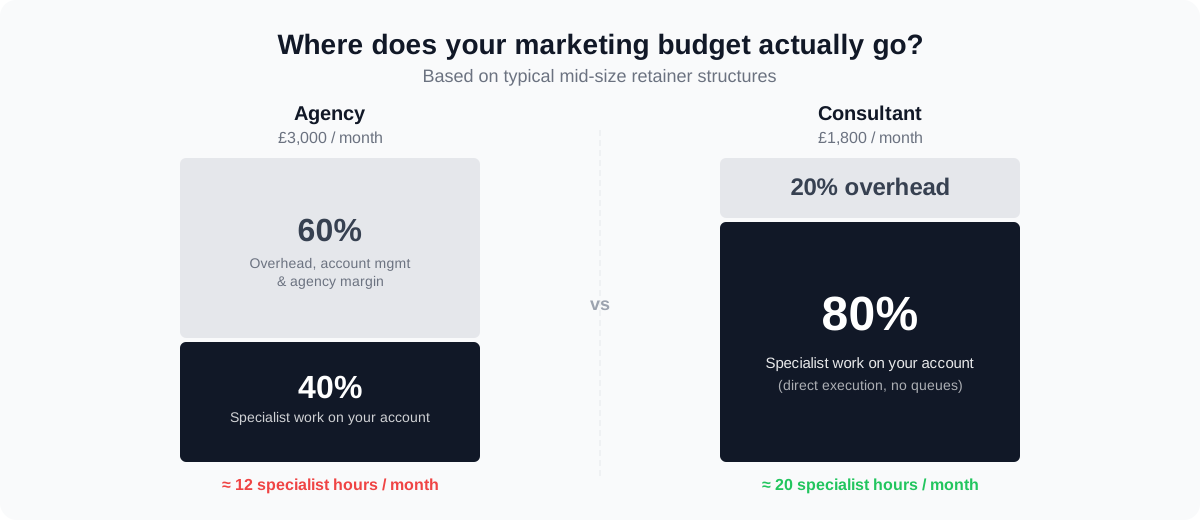
Consultants are not always cheaper on paper. But the value per pound is significantly higher when you work directly with a specialist rather than through a layered account management structure.
For businesses spending under £100,000 per year in ad spend, the agency overhead model rarely makes economic sense once you look at it this way.
This is exactly the model I work to. I take on a small number of clients and work with each one directly. No account manager between us. No junior team running your campaigns while a senior shows up for the monthly call. You get me: someone who has managed Google Ads budgets from £5,000 to £500,000 a month, rebuilt broken account structures, fixed attribution gaps, and improved ROAS for e-commerce brands, lead generation businesses, and SaaS companies. If you want to know whether your current setup is leaving money on the table, a free audit conversation is the fastest way to find out.
What I found when I audited a real account
I worked with an e-commerce client who had been running Google Ads with a large agency for two years. Monthly retainer was around £4,500. Monthly ad spend was £12,000. ROAS was averaging 2.1, which barely covered margins after product cost and fulfillment.
When I audited the account, three things stood out immediately: single keyword ad groups that had never been tested against alternatives, a remarketing list with no audience exclusions applied, and a budget split that had not been reviewed despite clear seasonal patterns in the business.
Within 90 days of taking over management, ROAS improved to 3.6. The monthly management fee dropped to £2,200. The saving on retainer alone covered the cost of switching over in the first quarter. The performance improvement on top of that was compounding.
The agency was not incompetent. They were spread across too many accounts, with too little specialist time per client, and no real financial incentive to go deeper.
When agencies do make sense
Worth saying clearly: agencies are not always the wrong choice.
Larger businesses with complex multi-channel needs, paid search, display, programmatic, SEO, creative, and analytics, often benefit from a single agency partner that can coordinate across all of those functions. The overhead cost is justified by the coordination value, especially when internal marketing teams are thin.
Businesses that genuinely need content production at scale, design resources, and strategy development under one roof may also find that an agency structure earns its keep.
And if a company has very limited internal marketing capability, the account management layer that feels frustrating to a performance-savvy founder can actually be useful for businesses that need someone else handling briefing, approval, and delivery coordination.
The question to ask is not "agency or consultant?" A better one is: does the structure I am paying for match what my business actually needs right now?
How a lean consultant model improves ROI, speed, and accountability
Working with a specialist performance marketing consultant changes the dynamic in three practical ways.
Speed: No internal queue. If a test needs to go live, it goes live. If a campaign is burning budget on irrelevant search terms, it is fixed the same day. That kind of responsiveness is something most businesses only appreciate once they have experienced the alternative.
Accountability: A good consultant has their name on the results. Not a team of five, not a department. One person you can call directly, with a professional reputation tied to your outcome. The quality of attention your account gets changes noticeably as a result.
Honesty: Consultants who rely on long-term client relationships have a strong incentive to give direct, commercial advice rather than polished slides that paper over weak performance. If your landing page is converting poorly, a good consultant will say so and help fix it. That kind of directness is harder to find inside a structure designed to retain monthly revenue regardless of what the numbers say.
When specialist hours replace overhead hours, the money you spend on management goes further. Better decisions get made faster. Consistent, high-quality optimisation over 6 to 12 months typically outperforms inconsistent, layer-heavy management, even when the agency has more people on paper.
How to reduce ad spend waste regardless of who manages your campaigns
Whether you are with an agency, a consultant, or managing campaigns in-house, the same fundamentals apply to cutting wasted ad spend:
- Review your search terms report weekly. Most wasted budget is found here, not in bidding strategy. One hour a week reviewing and adding negative keywords is one of the highest-ROI activities in paid search.
- Run your numbers against real margins. A 3x ROAS can be profitable for a high-margin product and loss-making for a low-margin one. The ROAS calculator on this site can help you model break-even and net profit in under a minute.
- Separate brand and non-brand campaigns. Mixing the two hides true performance and makes intelligent budget allocation nearly impossible.
- Test landing pages against ad copy intent. Most accounts underperform not because of bad bidding, but because traffic lands on pages that do not match what the ad promised. A higher conversion rate on the same traffic is always the cleanest path to better ROAS.
- Ask for a search impression share breakdown. If you have low impression share due to budget limitations on high-intent queries, you are likely leaving better-qualified conversions on the table.
None of these are advanced tactics. They are the basics that regularly get skipped when accounts are spread thin across too many clients with too little specialist time allocated per account.
My take
If you are spending serious budget on digital marketing and your results do not match your investment, the problem is rarely the channel. It is usually the structure around it.
Agency, consultant, or in-house marketing is ultimately a question of fit. The right choice depends on your budget size, internal capability, the complexity of your channel needs, and how much you value direct accountability over convenience.
If you are a growth-stage business running Google Ads with under £100,000 in annual ad spend, the math almost always favors a specialist consultant over a full-service agency retainer. The overhead you are paying for is unlikely to be producing proportional value.
If you want to understand what a leaner, more accountable model looks like in practice, I am happy to have that conversation. No pitch deck, no discovery call theater. Just a direct discussion about your numbers and whether there is a smarter way to structure your marketing spend.
Get weekly growth ideas in your inbox
Practical SEO, PPC, analytics, and CRO notes with zero spam.
Frequently Asked Questions
Is a marketing consultant cheaper than an agency?▾
What is the real cost of hiring a marketing agency?▾
When does using an agency make more sense than a consultant?▾
How do I reduce ad spend waste in Google Ads?▾
What is the difference between agency and in-house marketing?▾
How can I improve digital marketing ROI without increasing spend?▾

Digital marketing consultant — SEO, PPC, analytics & CRO.