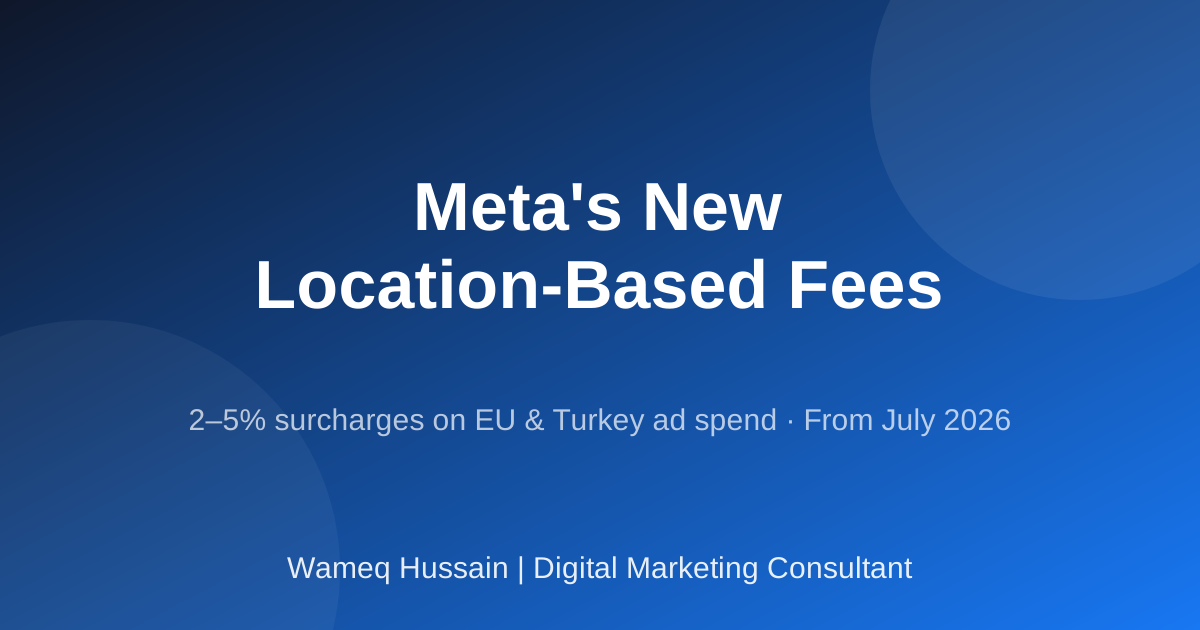
From July 2026, Meta will add location-based surcharges of 2–5% on ads delivered in several European markets. Here is exactly how the fees work, which countries are affected, and how to adjust your budgeting.
What Meta is doing and why
Starting July 1, 2026, Meta will introduce location-based surcharges on ad campaigns delivered in certain European markets. These charges are a direct response to Digital Services Taxes (DST) that governments across Europe have been rolling out over the past few years. Until now, Meta absorbed these regulatory costs internally. From mid-2026, they are passing them on to advertisers.
This is not a platform fee increase or a change to ad auction dynamics. It is a tax pass-through — Meta collecting the government-mandated DST from advertisers rather than paying it from its own revenue. The distinction matters because it affects how you should think about budgeting, not bidding strategy.
Which countries are affected and by how much
At launch, the surcharges apply to six markets:
- Austria — 5%
- Turkey — 5%
- France — 3%
- Italy — 3%
- Spain — 3%
- United Kingdom — 2%
The rate is determined by where the ad impression is served — the location of the person who sees the ad — not where the advertiser's account is registered or billed. This is an important distinction that catches a lot of international advertisers off guard.
Want this implemented for your funnel?
Get a free 90-day growth plan with tracking, channel priorities, and next-week actions.
How the billing actually works
Your campaign budget is not reduced by the surcharge. Meta spends the full amount you set, and the location fee is added as a separate line item on your invoice after delivery. Each jurisdiction appears as its own itemised charge, so you can see exactly how much was attributed to each country.
Here is a simple example: if you run a €100 campaign and all impressions are delivered in Italy, your invoice shows €100 for the campaign plus €3 for the Italy location fee, totalling €103. VAT is then calculated on that combined €103 figure — not just the original €100. For mixed-market campaigns, each geo-split carries its own surcharge line.
Who this affects beyond European businesses
The geography of your billing account makes no difference. If you are running Meta campaigns from the UAE, the US, Pakistan, or anywhere else, and your targeting includes European audiences, you pay the same surcharges as a business physically located in those countries. The fee follows the impression, not the advertiser.
This catches a lot of international brands and agencies off guard. If your Meta account is billed in USD but you are targeting French or Italian users as part of a global campaign, those impressions will still attract the 3% surcharge. It will show up on your invoice regardless of your account currency or billing country.
What this means for your ROAS and CAC targets
The practical impact depends on how much of your Meta spend goes to affected markets. For advertisers running broad European campaigns, the blended cost increase is meaningful. If your EU spend is split across France, Italy, Spain, the UK, and Austria, you are looking at an effective average surcharge of around 3–3.5% on that portion of your budget.
For performance marketers, this needs to feed into your ROAS and CAC targets at the market level. A campaign that was hitting its efficiency threshold in Italy at €100 CPL now costs €103 before VAT. That gap is small at low spend levels but compounds quickly at scale. If you run monthly Meta budgets of €50,000+ in Europe, the location fees represent a real budget line that needs to be accounted for in advance, not discovered on the invoice.
The right adjustment is straightforward: increase your gross budget in affected markets by the relevant surcharge percentage, or lower your CPA targets to reflect the true all-in cost. Do not let the fees silently erode performance benchmarks that were set before this change.
How to prepare before July 1, 2026
There are three things worth doing now:
- Audit your geo-targeting: Pull a breakdown of your Meta spend by country for the last 90 days. Identify what percentage is going to the six affected markets and estimate the fee impact at each rate.
- Update your budget models: Add the surcharge as a separate cost line in your media planning templates. For blended campaigns, calculate a weighted average surcharge based on your impression distribution across affected markets.
- Revise your performance benchmarks: If your CPA, ROAS, or CAC targets were built on pre-surcharge cost assumptions, update them now. This is especially important for agencies running campaigns on behalf of clients — the client needs to understand the all-in cost of acquiring a customer in France or Italy has increased, even if bid strategy and creative have not changed.
The bigger picture: DST is spreading
France, the UK, Austria, Italy, and Spain are not the only countries with Digital Services Taxes in the pipeline. Several other markets globally are developing similar frameworks, and Meta is likely to extend this pass-through model to new markets as those taxes take effect. The July 2026 rollout in Europe and Turkey is probably the first of several waves.
For advertisers with significant international spend, this is worth tracking as a category-level cost trend — not just a one-time billing change. The broader implication is that the era of platforms silently absorbing regulatory compliance costs is ending. As governments increase platform taxes, advertisers should expect more of those costs to flow through to media budgets over time.
If you want help modelling the impact on your specific Meta budget or adjusting your paid media planning to account for these fees, get in touch.
Source: Meta Business Help Center — Location-Based Taxes on Ads
Get weekly growth ideas in your inbox
Practical SEO, PPC, analytics, and CRO notes with zero spam.
Frequently Asked Questions
Which countries are affected by Meta's location-based fees?▾
Do the location-based fees count against my campaign budget?▾
I am based outside Europe but target EU audiences. Do I pay the fees?▾
How should I update my Meta ad budgets to account for these fees?▾
Will VAT be calculated on the fees too?▾

Digital marketing consultant — SEO, PPC, analytics & CRO.