
A/B Testing
A controlled experiment comparing two versions of a page, ad, or email to determine which performs better for a defined metric. Statistical significance is required before declaring a winner and rolling out changes.
How A/B Testing works in practice
The most common mistake in A/B testing is stopping tests early based on apparent winners before reaching statistical significance — false positives peak around 20–30% of the required sample size and then regress. At 95% confidence with a 10% minimum detectable effect, most e-commerce pages require 500–2,000 conversions per variant depending on baseline conversion rate. A/B tests should test one hypothesis per experiment — changing multiple elements simultaneously (multivariate testing) requires significantly more traffic to detect effects and makes attribution of improvement ambiguous. Tools like Optimizely, VWO, and AB Tasty handle significance calculations automatically; when running experiments in GA4, use Explore's Experimentation feature or a dedicated stats calculator to avoid premature conclusions.

Your digital consultant
Hi, I'm Wameq.
If your data looks fine but decisions still feel like guesses, your measurement setup needs work.
Let's talk →This term sits in the Analytics category, which means it is most useful when evaluating measurement design, attribution quality, reporting accuracy, and decision-making. The goal is not to memorize the label. The goal is to know when it should change a decision, a page, a campaign, or a measurement setup.
Related terms
The systematic process of increasing the percentage of visitors who take a desired action, using data, UX research, and controlled experiments rather than guesswork. CRO compounds ROAS improvements without increasing ad spend.
A standalone page designed to receive traffic from a specific campaign and drive a single conversion action. Effective landing pages have message match with the ad, a clear CTA, social proof, and minimal navigation distractions.
Mapping and measuring the sequential steps users take toward a conversion goal. Funnel analysis pinpoints where users drop off so optimisation effort is directed at the highest-impact bottlenecks.
Put A/B Testing to work
Understanding A/B Testing is one thing — operationalising it across tracking, acquisition, and conversion is another. Explore the full range of digital marketing services, including SEO & content consulting, paid media management, and analytics & CRO. Or work directly with a digital marketing consultant in Dubai on building growth systems that actually compound.
Learn more: related articles
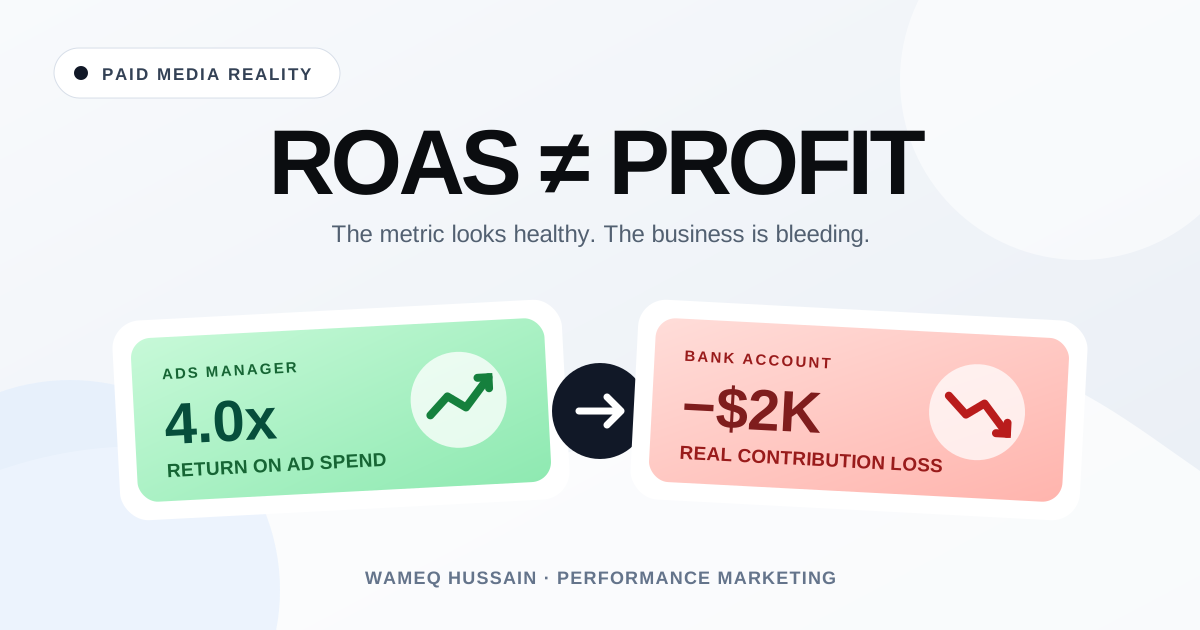
Why Your Ads Look Profitable but Your Business Is Still Losing Money
Your ads report healthy ROAS while margin keeps shrinking. See where the numbers split—and how to measure whether paid media actually makes money.

Crypto Exchange Marketing: The 2026 User Growth Playbook
The crypto user base is heading from roughly 600 million in 2026 toward 1.2 billion by 2035, but the channels that grew exchanges in the last cycle are throttled, expensive, or compliance-restricted. This is the full-funnel playbook for acquiring, activating, and retaining funded traders in 2026 — trust signals, AI-search visibility, paid acquisition across restricted channels, community loops, and measurement that survives an audit.
How to Measure PPC Performance When AI Controls the Auction
AI Max, Performance Max, and Smart Bidding have taken over the inputs that PPC teams used to control — keywords, bids, match types, placements. That means most of the metrics your dashboard still shows are describing a game that no longer exists. Here is the four-layer measurement stack that actually tells you whether a 2026 paid account is working: profitability, incrementality, blended CAC, and first-party data quality.