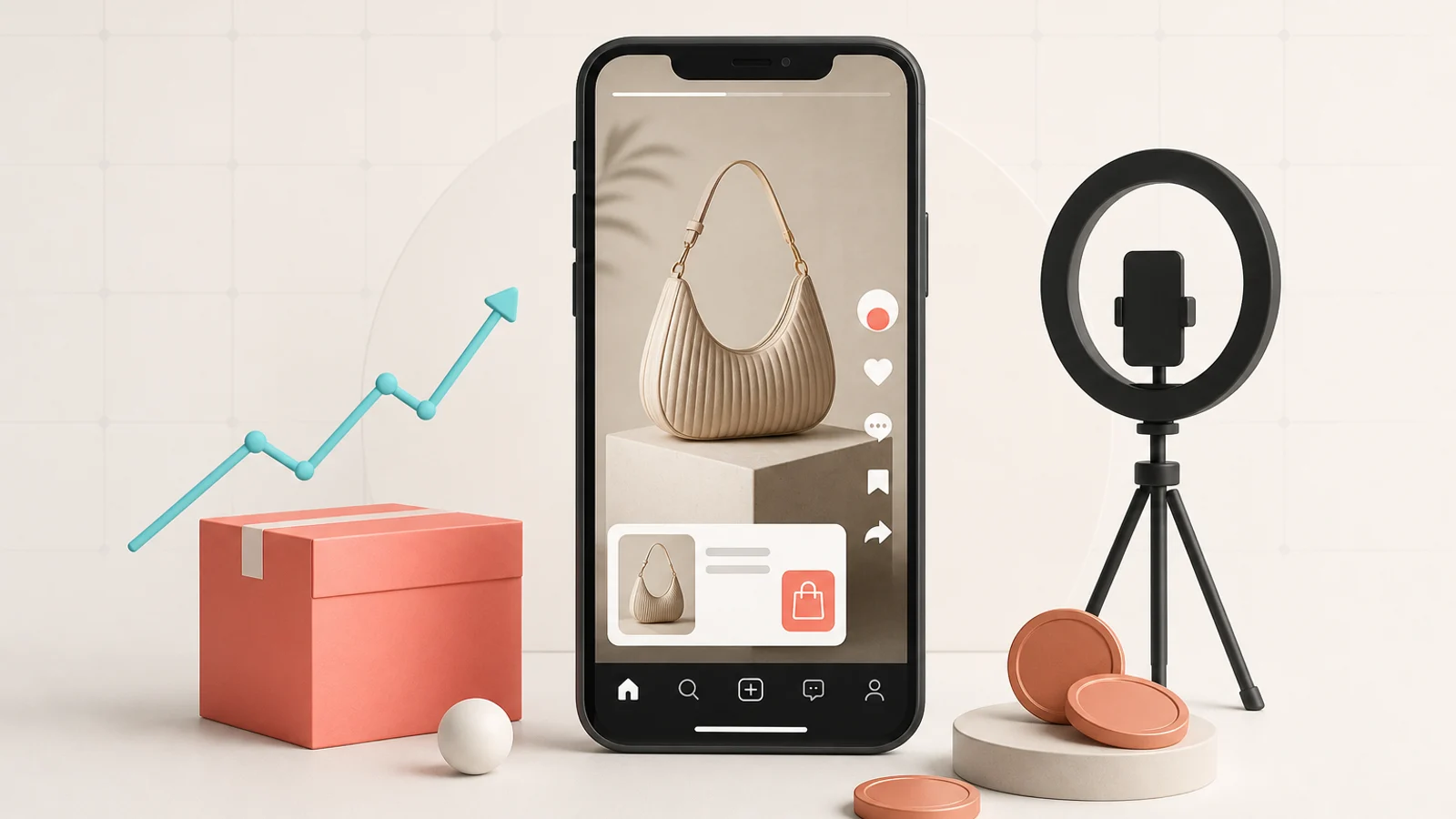
A practical beginner guide to TikTok Shop: choose the affiliate or seller route, find products people will actually buy, create shoppable videos, and work toward your first sale without falling for get-rich-quick nonsense.
First, ignore the easy-money version
If you search TikTok Shop on YouTube or TikTok, you will see the same promise repeated: pick a viral product, post a few videos, and wake up to commission.
That can happen. It is not a plan.
TikTok Shop is a real commerce channel, but the income comes from doing ordinary commercial work very quickly: choosing a product, understanding the buyer, making useful content, measuring the response, and repeating what converts. The platform makes checkout easier. It does not make people buy bad products from content they do not trust.
This guide is for someone starting from zero who wants the clean route—not fake screenshots, bought followers, or a “seller account loophole” that can create verification and policy problems later.
How people actually make money on TikTok Shop
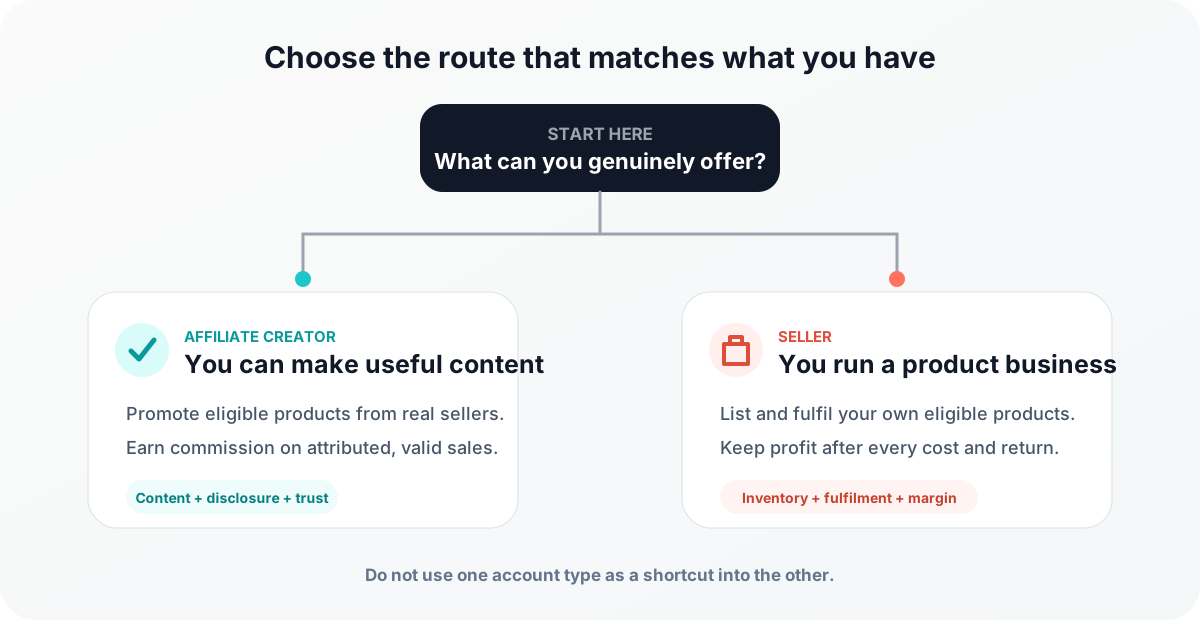
There are two main routes. Pick one before you do anything else.
| Route | What you do | How you earn | What you are responsible for |
|---|---|---|---|
| Affiliate creator | Choose eligible products from other sellers and feature them in shoppable videos or LIVE content. | A seller-funded commission on attributed, eligible sales. | Product selection, content, disclosure, and following creator policies. |
| Seller | List your own eligible products and sell through your content, affiliates, LIVE, or Shop ads. | Revenue minus product cost, platform charges, fulfilment, creator commission, ads, returns, and tax. | Inventory, listings, pricing, shipping, customer service, returns, compliance, and profit. |
If you do not own a product business and you mainly want to make content, the affiliate route is the sensible place to look. If you already source, manufacture, or legitimately resell products, use the seller route.
A seller account is not an affiliate shortcut. TikTok asks sellers to verify who they are and what they sell. Pretending to be a business to bypass a creator rule is a weak foundation for anything you want to keep.
Want this implemented for your funnel?
Get a free 90-day growth plan with tracking, channel priorities, and next-week actions.
Can you start without followers?
This is where most guides become unreliable.
For sellers, TikTok's current US guidance says you can join with zero followers, provided you meet the relevant identity, residence, business, and product requirements. For affiliate creators, requirements vary by country, account, and programme.
There is also a genuine documentation problem. TikTok's US Creator Eligibility Policy describes a 1,000-follower minimum for affiliate creators and a pilot programme for some new creators below 5,000. A separate Creator Center overview describes 5,000 or more followers. Markets outside the US have their own rules.
So I would not build your plan around a number copied from somebody else's dashboard. Open TikTok, go to your creator tools, and check whether TikTok Shop for Creator is available on your account. That screen is more useful than a blog post—including this one—because eligibility changes.
Step 1: choose one narrow product lane
Do not start with “viral products”. That is too broad and usually too late.
Start with a buyer and a recurring problem you can demonstrate. For example:
- small-space kitchen tools for renters;
- desk accessories for people working from home;
- simple car-cleaning tools for first-time car owners;
- travel organisers for cabin-bag travellers;
- hair tools for one specific texture or routine.
A narrow lane gives the algorithm and the viewer a clear signal. It also lets you reuse research. After ten videos about random products, you have ten disconnected experiments. After ten videos for the same type of buyer, you have the beginning of a content system.
Step 2: score the product before you chase it
I would rather promote a boring product with a clear demonstration than a fashionable product that only works when you exaggerate.
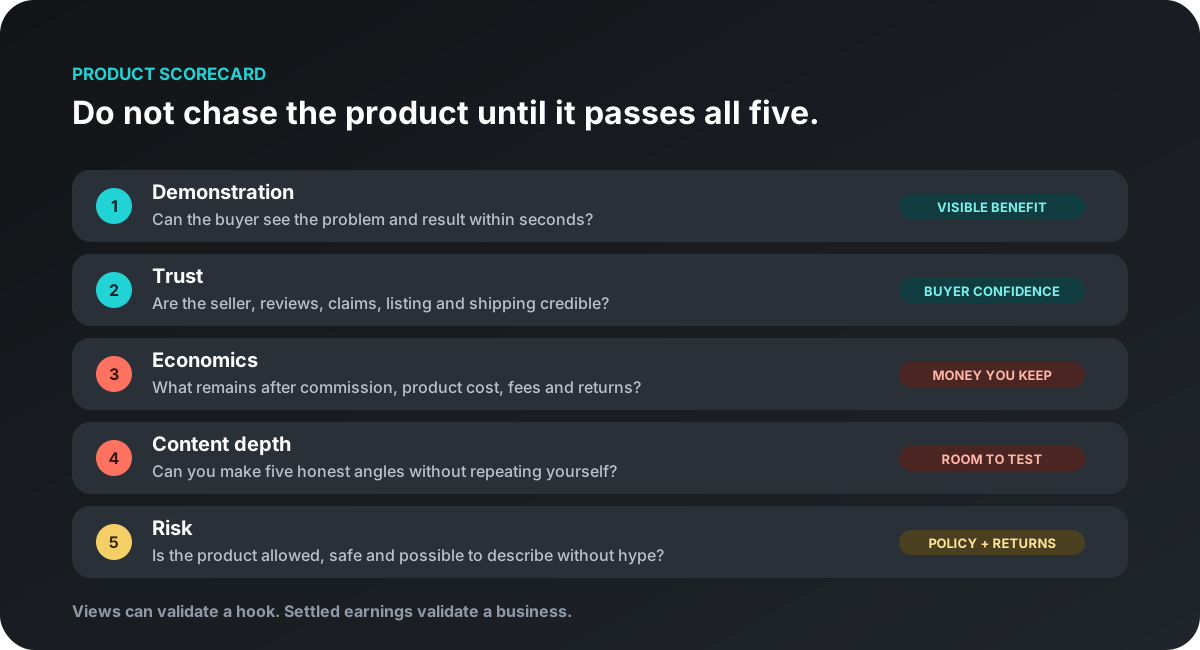
Before adding a product to your showcase or inventory, check five things:
- Demonstration: can the benefit be shown clearly in the first few seconds?
- Trust: are the listing, reviews, seller history, shipping promise, and product claims credible?
- Economics: is the commission or seller contribution margin worth the work after realistic returns and costs?
- Content depth: can you create at least five honest angles without repeating the same video?
- Risk: is the category allowed, and can you discuss it without making health, income, safety, or performance claims you cannot prove?
For an affiliate, the commission rate is only one input. A hypothetical $25 item at 15% commission produces $3.75 before cancellations, returns, or tax. One hundred valid sales would be $375—not the $2,500 gross merchandise value shown in a flashy screenshot. Always do that calculation before you decide a product is “high earning”.
Step 3: set up the account the proper way
If you are an affiliate creator
- Check TikTok Shop for Creator inside your account and complete the requested age, identity, tax, and payout steps.
- Choose products from the product marketplace that fit your lane.
- Review the seller, estimated commission, sample terms, shipping, ratings, and recent product performance.
- Request a sample where available, or begin with a qualifying product you already own and can demonstrate honestly.
- Add the correct product to your showcase and attach it to each relevant video or LIVE.
TikTok's official beginner affiliate guide covers the Creator Center, sample requests, and posting a first shoppable video. The exact screens differ by market, but the workflow is broadly the same.
If you are a seller
- Create the Seller Center account for your actual country and business type.
- Complete identity or business verification with matching information.
- Set warehouse, return, shipping, tax, and payment details.
- Build a complete product listing with accurate images, variation data, claims, inventory, and delivery expectations.
- Link the official TikTok account you will use for shoppable content.
The official TikTok Shop seller registration guide and shop setup guide are the pages to follow for current onboarding. Do not copy another country's checklist and assume it applies to you.
Step 4: make videos that help someone decide
A TikTok Shop video is not a television ad. It is a compressed buying decision.
A simple format is enough:
- Hook the problem: show the annoying situation immediately.
- Demonstrate the product: let the viewer see the mechanism, not just the packaging.
- Give one proof point: compare the before and after, show the fit, time the task, or answer the obvious objection.
- State the trade-off: mention who should not buy it or what it does not do. This builds more trust than pretending it is perfect.
- Make the next step clear: tell the viewer the product is attached without inventing urgency.
Here is a usable script:
“I kept having this problem. I tried this because it claims to fix one specific part of it. Here is what happened. This is the part I liked, this is the limitation, and I have attached the exact version I tested.”
You do not need to show your face in every video. Hands, screen recordings, voice-over, close demonstrations, comparisons, and simple point-of-view clips can work. But faceless should not mean evidence-free. If anything, the product needs to do more of the trust-building.
Step 5: run a seven-day first-sale sprint
Do not spend three weeks designing a logo for a TikTok account that has no content. Run a small, controlled test.
- Day 1: choose one buyer, shortlist three products, and score them.
- Day 2: select one product and write five hooks based on five different problems or objections.
- Days 3–5: publish one useful video each day. Change the hook or angle, not everything at once.
- Day 6: answer real comments with a reply video. Do not manufacture questions.
- Day 7: review watch time, product clicks, orders, cancellations, and earnings or margin. Decide what to repeat.
Three videos are not enough to declare a product dead, but they can expose a weak hook. If people watch but do not click, the offer or call to action is weak. If they click but do not buy, inspect price, reviews, shipping, product page quality, and trust. If they buy and return, the content or listing may be setting the wrong expectation.
The metrics I would actually watch
| Metric | What it tells you | What to do next |
|---|---|---|
| Early retention | Whether the opening earns attention. | Test a clearer problem, faster demonstration, or stronger first frame. |
| Product clicks | Whether viewers want to inspect the offer. | Make the product benefit and attached link clearer. |
| Click-to-order rate | Whether the listing converts interested traffic. | Review price, reviews, shipping, trust, variations, and listing accuracy. |
| Settled commission or contribution margin | What you actually kept. | Scale only after fees, commission, product cost, returns, and cancellations. |
| Return and cancellation rate | Whether the sale was healthy. | Fix misleading content, weak fulfilment, sizing, quality, or the product itself. |
Views sit at the top of this chain. They help you diagnose creative. They do not pay you on their own.
What I would not do
- Buy followers. A larger irrelevant audience does not create purchase intent and can create account-quality problems.
- Open a fake seller account to bypass creator rules. Use the account type that matches what you actually do.
- Copy another creator frame for frame. Learn the angle, then produce your own demonstration and opinion.
- Promote products you cannot verify. Especially avoid unprovable medical, financial, safety, and income claims.
- Hide the commercial relationship. Use the platform's disclosure tools and the disclosures required in your country.
- Scale from estimated earnings. Wait for actual settled results and look at returns.
- Pay a stranger to “unlock” your account. Use official TikTok and Seller Center routes; fake affiliate portals and account-takeover scams exist.
How to scale after the first consistent sales
Once one product and angle produce repeatable, settled sales, scale in layers:
- Make more versions of the winning angle with new hooks, demonstrations, objections, and use cases.
- Add one adjacent product for the same buyer instead of switching to a random niche.
- Build a simple weekly content rhythm: demonstrations, comparisons, objection replies, and LIVE sessions where appropriate.
- If you are a seller, open affiliate collaboration deliberately. TikTok supports open and targeted collaborations, with sellers setting commission terms for eligible products.
- Only consider paid Shop ads after organic content shows which product, creator, and message can already convert. My separate TikTok Ads guide covers the paid side.
The important word is after. Ads can distribute a working offer. They cannot repair a weak product, dishonest creative, slow fulfilment, or bad reviews.
The bottom line
TikTok Shop can become an income stream. Treat it like one.
Choose the correct route. Pick a narrow buyer and a product you can demonstrate honestly. Publish enough variations to learn. Follow the actual rules shown in your market. Then measure the money that remains after the sale—not the view count and not the gross sales screenshot.
Your first goal is not to go viral. It is to prove that one useful piece of content can produce one valid sale. Once you can repeat that without misleading anyone, you have something worth scaling.
Get weekly growth ideas in your inbox
Practical SEO, PPC, analytics, and CRO notes with zero spam.
Frequently Asked Questions
Can a beginner really make money with TikTok Shop?▾
How many followers do you need for TikTok Shop affiliate?▾
Can you start TikTok Shop without followers?▾
Do you need to buy products before promoting them?▾
How much can you earn from TikTok Shop?▾
What products sell best on TikTok Shop?▾

Digital marketing consultant — SEO, PPC, analytics & CRO.