
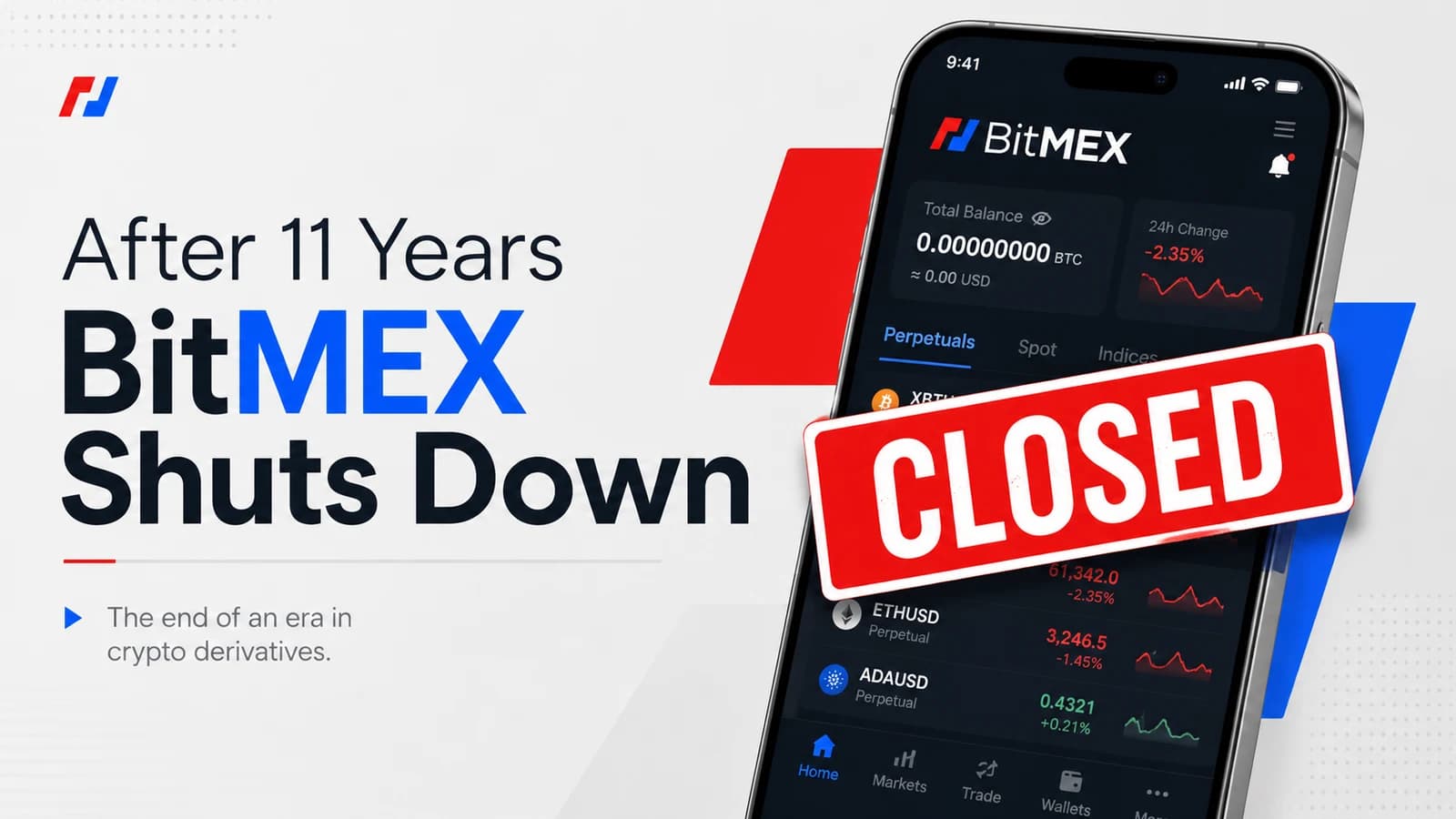
BitMEX invented the 100x perpetual swap, held roughly 57 percent of crypto derivatives at its peak, and closes on 23 September 2026 with almost no volume left. This is what it built, what went wrong, what users need to do before the deadline, and what the collapse teaches anyone growing a crypto product.
The short answer
BitMEX is shutting down because almost nobody trades there any more.
On 23 July 2026, HDR Global Trading Limited announced that the BitMEX exchange will cease operations on 23 September 2026 at 04:00 UTC, following a strategic review of the business and, by its own account, several unsuccessful attempts to sell it. New account registrations closed the same day.
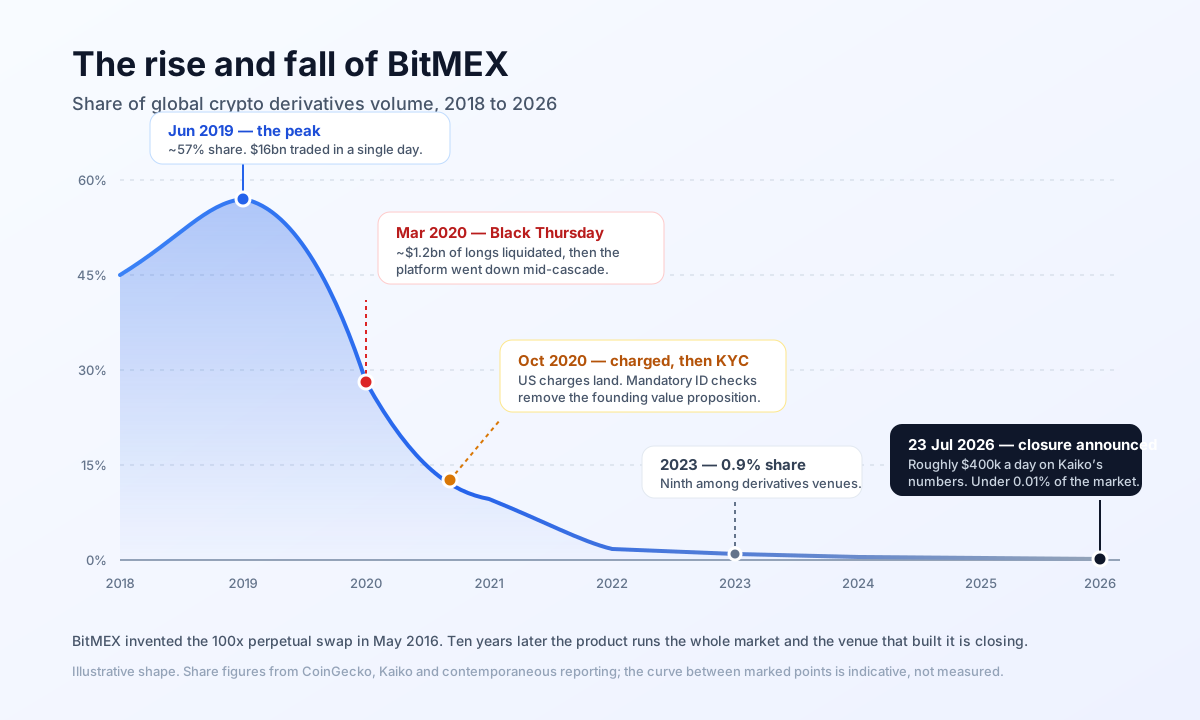
The number that explains everything: BitMEX was doing roughly $400,000 in daily volume by July 2026 on Kaiko's figures — under 0.01 percent of the market. At its peak in June 2019 it traded $16 billion in a single day and held something in the region of 57 percent of all crypto derivatives volume.
That is not a company that failed financially. BitMEX says assets exceed liabilities, it never lost customer funds to a hack in 11 years, and it is closing through a scheduled withdrawal window rather than a bankruptcy filing. It is a company that lost its market and could not find anyone willing to buy what was left.
What follows is the full story: what BitMEX built, why it dominated, the four decisions that unwound it, and what users need to do before the deadline.
What BitMEX users need to do, and by when
Take this part first, because the dates matter more than the history.
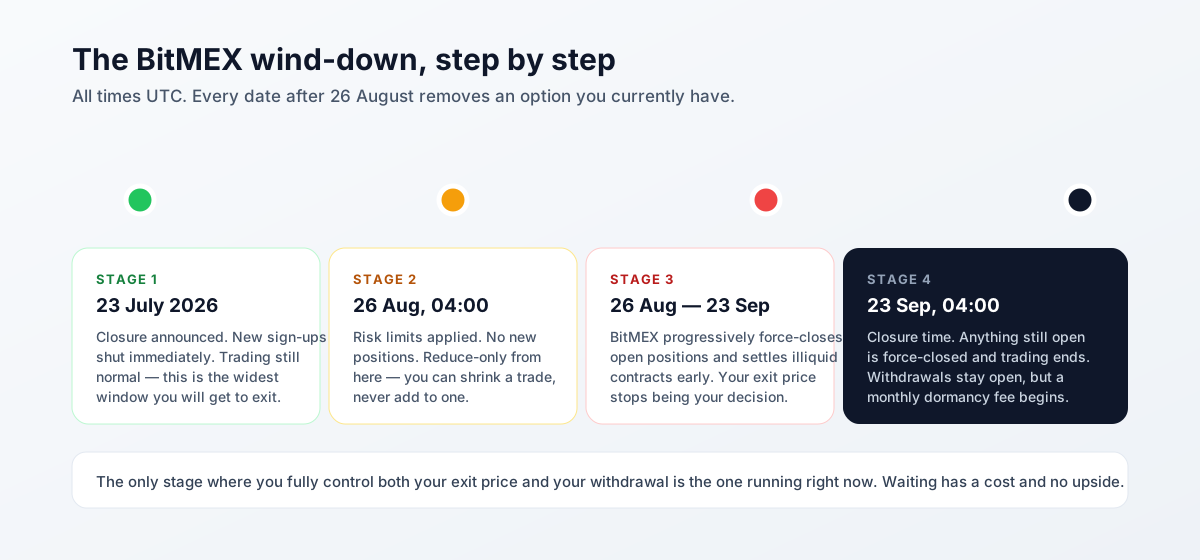
| Date (UTC) | What changes | What it means for you |
|---|---|---|
| 23 July 2026 | Closure announced. New registrations closed. Trading continues normally. | This is your widest window. Full control of entry, exit and withdrawal. |
| 26 August, 04:00 | Risk limits applied. No new positions — reduce-only. | You can shrink a position, never add to one. Hedging becomes impossible. |
| 26 Aug – 23 Sept | BitMEX progressively force-closes open positions; illiquid contracts settle early. | Your exit price stops being your decision. |
| 23 September, 04:00 | Closure time. Everything still open is force-closed. Trading ends permanently. | Login remains for balances, history and withdrawals only. |
Three things worth knowing that most coverage got wrong or skipped:
- Withdrawals are not cut off on 23 September. You can still withdraw after the closure time. It is a wind-down, not a lockout.
- But waiting costs money. Verified users who have not withdrawn by the closure time are charged a monthly dormancy fee — the greater of USD 50 equivalent or 1 percent per annum of the remaining balance, with BitMEX reserving the right to raise it on notice. On a small balance, that fee eats the balance.
- Staked BMEX has already been returned to holders' accounts.
BitMEX has also issued a phishing warning: nobody can offer you an expedited or priority withdrawal. Any message promising one is a scam, and shutdown announcements are exactly when those campaigns spike.
The practical advice is boring and correct. Close your positions and withdraw now, in the stage where both decisions are still yours.
Want this implemented for your funnel?
Get a free 90-day growth plan with tracking, channel priorities, and next-week actions.
What BitMEX was
BitMEX — the Bitcoin Mercantile Exchange — launched publicly in November 2014, founded by Arthur Hayes, Ben Delo and Samuel Reed. Hayes was a former equity derivatives trader in Hong Kong. Delo was an Oxford maths and computer science graduate who had built high-frequency trading systems in traditional finance. Reed was the engineer.
They did not start with venture money. A friends-and-family round, a SAFE in July 2015, and a place in SOSV's Chinaccelerator programme is the entire funding story. Everything after that was funded by trading fees.
The company was registered in the Seychelles under HDR Global Trading Limited, and that jurisdictional choice — plus a decision to accept only Bitcoin, never fiat — is the hinge on which the whole story turns. No fiat rails meant no banking relationships. No banking relationships meant, for a while, no banking regulators. And for the first six years, no identity checks at all.
Why BitMEX became the biggest venue in crypto
In May 2016 BitMEX launched XBTUSD: the perpetual swap. This is the part of the story that outlives the company.
A perpetual swap is a futures contract with no expiry date. Instead of settling on a fixed date, it is anchored to the spot price through a funding rate — a periodic payment between longs and shorts that pulls the contract back toward the index whenever it drifts. Positive funding, longs pay shorts. Negative, shorts pay longs.
That single mechanism solved the problem that had made crypto futures unusable for retail: rolling contracts. It gave traders a position they could hold indefinitely with leverage, and it gave the exchange a self-correcting price without needing deliverable settlement.
Around it, BitMEX built the rest of the stack that every venue now copies:
- 100x leverage with non-recourse liquidation. You could lose your margin. You could never owe more than it. That asymmetry is what made 100x psychologically tradeable rather than reckless.
- Fair price marking. Positions were marked against the .BXBT index — a volume-weighted composite of external spot venues — rather than BitMEX's own last-traded price. It meant a wick on BitMEX's own book could not liquidate you. Nearly every exchange marks this way now; almost none did then.
- The insurance fund. Capital accumulated from liquidations executed at better-than-bankruptcy prices, held to absorb losses so that profitable traders were not clawed back. At its peak it exceeded 35,000 BTC.
- Auto-deleveraging. The explicit, published backstop for when the insurance fund is exhausted. Unpleasant, but transparent — and now industry standard.
- A full testnet. A complete mirror of the platform running on testnet Bitcoin. An entire generation of crypto quants and bot developers learned to build against the BitMEX API because they could break things for free.
- BitMEX Research. An in-house research arm whose forensic work on Tether and Bitcoin protocol mechanics gave the company credibility far beyond its size.
And then there was the culture. BitMEX ran a bot that broadcast every liquidation — instrument, size, direction, price — into a public feed. The @BitmexRekt account turned other people's ruin into spectator sport and put the word "rekt" permanently into the crypto vocabulary. Researchers who studied the platform catalogued over 425,000 liquidation events across 205 instruments, totalling around $60 billion.
By mid-2019 BitMEX was doing over $1 trillion a year. On 26 June 2019 it traded roughly $16 billion in a day, more than $13 billion of it XBTUSD alone. In March 2020 it held around 310,000 BTC on the platform.
It never got better than that.
Why BitMEX is shutting down: four things that compounded
No single event killed BitMEX. Four did, in sequence, each one making the next harder to survive.
1. Black Thursday broke the trust, March 2020
On 12–13 March 2020 Bitcoin fell roughly 45 percent, briefly trading below $4,000. BitMEX alone liquidated around $1.2 billion of long contracts — forced selling driving price down, triggering more forced selling.
Then the platform went offline. BitMEX suffered two DDoS attacks about ten hours apart on 13 March; it initially attributed the outage to a cloud provider hardware issue before confirming the attacks. The outage itself was short. The timing was catastrophic: it landed mid-cascade, when traders could not add margin or close positions to defend themselves.
The moment BitMEX went down, the sell pressure evaporated and Bitcoin snapped back toward $5,300. A widely-held market interpretation — never proven, and worth treating as interpretation rather than fact — is that the outage stopped Bitcoin going to zero on BitMEX, because the liquidation engine would otherwise have kept eating the order book.
Two things followed. BitMEX refunded roughly 40 BTC to 156 customers for erroneous liquidations. And traders asked a question the company never answered persuasively: why was a 35,000 BTC insurance fund barely drawn down in exactly the scenario it existed for? The suspicion that the fund was a profit centre harvested from liquidations rather than a trader safeguard took root then, and it resurfaced in litigation six years later.
Open interest halved and never recovered. By 7 April 2020 — less than a month later — BitMEX had been overtaken in daily Bitcoin futures volume by Binance, Huobi and OKEx. That is the precise moment the dominance ended.
2. The US charges, and the KYC that followed, October 2020
On 1 October 2020 the CFTC filed civil charges against five BitMEX entities and the three founders for operating an unregistered trading platform and failing to run an AML programme. The DOJ separately indicted Hayes, Delo, Reed and head of business development Gregory Dwyer for Bank Secrecy Act violations. Roughly 30 percent of the Bitcoin held on the platform was withdrawn in the aftermath.
BitMEX had already announced a user verification programme that August. After the charges it accelerated it hard, pulling the deadline forward to 5 November 2020, and soon announced that its active user base was 100 percent KYC-verified — the first major offshore derivatives venue to get there.
Commercially, this was the killing blow, and it is worth being clear about why. BitMEX's founding value proposition was pseudonymous, Bitcoin-only, high-leverage trading with no identity checks. Mandatory KYC did not damage that proposition. It deleted it. And it deleted it at a moment when several competitors still did not require the same thing.
The legal tail ran for years: a $100 million CFTC and FinCEN settlement in August 2021; guilty pleas and $10 million fines each from the founders in 2022, resulting in probation and home detention rather than prison; a corporate guilty plea from HDR in July 2024; a further $100 million fine in January 2025 plus two years of corporate probation. President Trump pardoned the founders — and, reportedly, the company itself — in March 2025.
By then the pardon was irrelevant to the business. Around $210 million had gone out of the door in penalties, on a revenue base that had been shrinking for four years.
3. Three years late to the product the market wanted
BitMEX's contracts were inverse: quoted in USD, margined and settled in Bitcoin. Elegant, and genuinely harder to reason about. Your position size is in dollars but your P&L is in BTC, so your exposure changes non-linearly as price moves.
Binance, Bybit and OKX offered linear USDT-margined perps instead. Post a stablecoin, take a position, see your P&L in the same unit. For the vast majority of retail traders it was simply easier, and easier wins.
BitMEX launched USDT-margined contracts in November 2021. The company's own blog post announcing the testnet rollout was headlined "Better Late than Tether", which is funnier than it is defensible. By then the market structure had already set. Liquidity had moved and it does not move back out of politeness.
The same lateness showed in listings. Competitors shipped hundreds of altcoin perps and captured every new narrative cycle. BitMEX's catalogue stayed narrow.
4. Liquidity is the product, and liquidity compounds elsewhere
This is the structural point, and it is the one worth carrying into any other business.
An exchange's product is not its contract specification. Its product is liquidity. Traders go where the book is deep, because depth is what determines whether you can actually get out at the price you see. Market makers go where the traders are, because that is where the flow is. Each one reinforces the other.
Run that loop in reverse and it is just as self-reinforcing. Thin books push traders out, which pushes market makers out, which thins the books further. There is no marketing budget that reverses it, because the thing users left over is not perception — it is execution quality, and they can measure it.
Meanwhile a second wave arrived. On-chain perpetual venues — Hyperliquid, dYdX, GMX and others — took perp DEX volume from $1.50 trillion in 2024 to $6.38 trillion in 2025 on CoinGecko's numbers. Hyperliquid alone traded over $190 billion in April 2026, ranking ninth across all venues, centralised or not. BitMEX's original pitch was permissionless leverage without an intermediary asking who you are. By 2026 that pitch existed again, on-chain, and BitMEX was not the one offering it.
The market share arc is brutal when you line it up: roughly 57 percent at the 2019 peak, ninth place and 0.9 percent by August 2023, out of the top ten by 2025, and effectively zero by July 2026. Platform holdings fell from about 310,000 BTC to roughly 13,300 BTC — a 96 percent decline.
Worth noting: BitMEX also died into a contracting market, not just a competitive one. Average monthly volume across the top perpetual venues fell about 34 percent between 2025 and 2026, and total open interest dropped from $120 billion to $99 billion. Nobody was well-placed to absorb a struggling venue.
The last eighteen months
In February 2025, after the $100 million fine, BitMEX retained Broadhaven Capital Partners to run a sale process. It ran roughly 17 months and produced no buyer.
Then, on 29 June 2026, the exchange lost its CEO, CFO and Chief Growth Officer simultaneously. Peter Wilkinson, previously global general counsel and COO, was appointed CEO. Twenty-four days later he was presiding over the closure announcement.
When a company cannot be sold and its senior leadership exits within a month, the announcement that follows is rarely a surprise to anyone inside it.
What this is not
It matters that BitMEX is closing the way it is closing.
There is no shortfall, no gate on withdrawals, no missing balance sheet, no founder on a flight. BitMEX published a proof of reserves page, stated that assets exceed liabilities, gave users two months of notice, and structured a staged wind-down with force-closing rather than a sudden halt. That is the opposite of FTX in every mechanical respect. It is obsolescence, not fraud.
Two caveats belong here, and leaving them out would be dishonest.
First, the insurance fund. Reported at roughly $270 million at the time of the announcement, and BitMEX has not said what happens to it after 23 September. That is a genuinely open question.
Second, on the same day as the closure announcement, a proposed class action was filed in the Southern District of New York by BKX Services Inc. and David Namdar, claiming 622.66 BTC — around $40.7 million — from BitMEX, HDR Global and the three co-founders. The complaint alleges that BitMEX designed a system to retain customer collateral and route the remainder into the insurance fund, and that an internal trading desk accessed private user information and continued trading during server freezes when other customers could not close positions. BitMEX did not respond to press requests for comment. These are unproven allegations, and they directly contradict the clean-record framing — which is a reason to watch the case rather than to pick a side today.
What BitMEX leaves behind
The perpetual swap is now the most important financial instrument in crypto, and it is not close.
Perpetual centralised exchanges processed $85.3 trillion in 2025 on CoinGecko's numbers. Derivatives account for roughly 73 percent of all crypto trading volume; in Q1 2026 derivatives did $18.63 trillion against $1.94 trillion of spot, a ratio of about 9.6 to 1. On decentralised venues, perps are around three quarters of volume. The design is now being extended beyond crypto entirely, into oil, gold, equities and FX.
Every one of those venues is running a version of a contract BitMEX shipped in May 2016 and never managed to defend. Binance, Bybit, OKX, Bitget, Deribit, Kraken, Hyperliquid, dYdX, GMX — all of them, some version.
Arthur Hayes' response to the closure, posted on X, was characteristically unbothered: "It was an amazing ride. We did something special together. And I'm so proud of what we created and that we will shutdown responsibly on our own terms." Binance's Changpeng Zhao and Bybit's Ben Zhou both posted tributes, which is a slightly strange thing to read from the people whose exchanges took the market.
The blunt version: BitMEX invented a product so good that it made the inventor irrelevant.
The commercial lesson, if you are building anything in crypto
I write about growth for exchanges and fintech products, so this is the part I actually care about, and it generalises well past crypto.
First-mover advantage is rented, not owned. BitMEX had the product, the brand, the developer mindshare and 57 percent of the market. It lost all of it in under four years, and it lost it to competitors offering a slightly easier version of the same thing. Inventing a category buys you a head start and nothing else.
The moat is distribution and depth, not the idea. Once liquidity left, no campaign could have brought it back — the deficiency users were leaving over was real and measurable. Whatever your equivalent of liquidity is, defend it weekly. If you run an exchange, the full picture of how acquisition, trust and community fit together is in my crypto exchange marketing playbook for 2026.
Compliance is a product decision, not a legal one. The KYC rollout was unavoidable by late 2020. But it was implemented as a legal remediation, not as a repositioning — and the company never replaced the value proposition it had just deleted. Compliance changes who your product is for. Something has to be rebuilt when that happens.
Trust is the conversion layer, and it is spent faster than it is earned. Black Thursday cost BitMEX more than any fine did. Users forgave the loss; they did not forgive being unable to act. If you are mapping where trust breaks in your own funnel, that is the subject of how to build a crypto marketing funnel that actually converts.
Community was the channel BitMEX had and abandoned. The trollbox, the REKT feed, the testnet, BitMEX Research — that was a genuine compounding asset and the only one with a falling cost curve. It was allowed to decay while the company fought its legal battles. That mechanism is covered in what community-led growth is and why it matters.
BitMEX ran for 11 years, invented the dominant instrument in its industry, never lost customer funds to a hack, and is closing in an orderly way with users made whole. That is a better ending than most of its contemporaries got.
It is still an ending.
Get weekly growth ideas in your inbox
Practical SEO, PPC, analytics, and CRO notes with zero spam.
Frequently Asked Questions
Why is BitMEX shutting down?▾
When exactly does BitMEX close?▾
Are BitMEX user funds safe? Can I still withdraw after 23 September?▾
What did BitMEX actually invent?▾
Was BitMEX ever hacked?▾
Is the BitMEX closure a sign of wider trouble in crypto?▾
What happens to the BMEX token?▾

Digital marketing consultant — SEO, PPC, analytics & CRO.