Google is moving Dynamic Search Ads into AI Max from February 2027. Here is what changes and how to test the migration without giving up control.
The deadline is real, but the panic is early
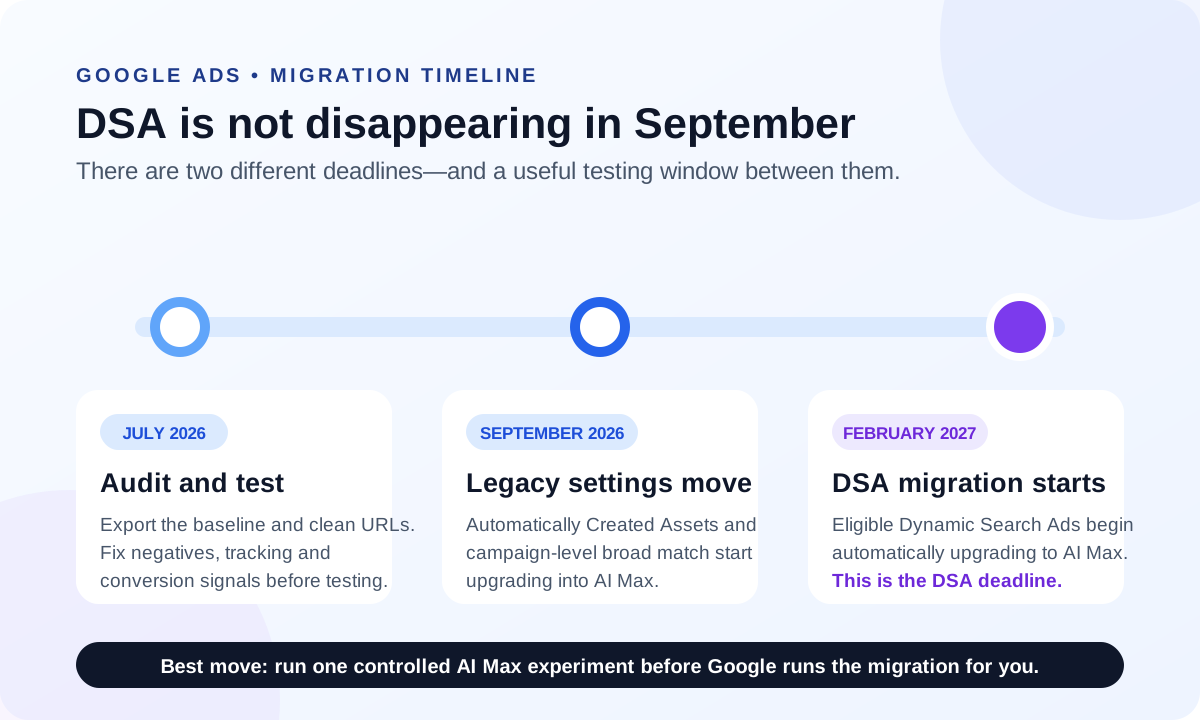
Dynamic Search Ads are going away in their current form. They are not vanishing tomorrow.
Google originally announced a faster transition, then updated the timeline in June 2026. The current position is that automatic DSA upgrades to AI Max will begin in February 2027. A separate change still begins in September 2026 for campaigns using Automatically Created Assets and the campaign-level broad match setting.
That distinction matters. I have already seen people turn the announcement into “all DSA campaigns die in September”. That is not what Google’s updated guidance says.
You have time. Use it. The worst response is to ignore the migration until Google handles it for you. The second-worst response is to switch AI Max on across the entire account because Google Ads showed you a recommendation card.
What AI Max actually is
AI Max is not another campaign type sitting beside Search and Performance Max. It is an automation layer inside a Search campaign.
When enabled, it can combine three main capabilities:
- Search term matching: Google expands beyond your keyword list using broad-match and keywordless technology, informed by your existing keywords, ads, and landing pages.
- Text customization: Google can generate or adapt ad copy using messages found in your ads, assets, and website.
- Final URL expansion: Google can send the user to a different page on your domain when it predicts that page is more relevant to the query.
Google’s AI Max documentation presents these as a connected optimization system. That is exactly why the migration needs testing. You are not changing one targeting option. You may be changing the query, the message, and the landing page at the same time.
Want this implemented for your funnel?
Get a free 90-day growth plan with tracking, channel priorities, and next-week actions.
DSA versus AI Max: the practical difference
Dynamic Search Ads already used your website to find relevant searches, generate headlines, and select landing pages. AI Max extends that logic across a standard Search structure and adds more automation around matching and creative.
| Area | Dynamic Search Ads | AI Max |
|---|---|---|
| Campaign structure | Dynamic ad groups and dynamic targets | Standard Search ad groups with an AI layer |
| Query matching | Primarily based on website content and dynamic targets | Keywords, broad matching, assets, landing pages, and keywordless matching |
| Creative | Dynamic headline with advertiser-written descriptions | Text customization can generate and adapt assets |
| Landing pages | Selected from eligible dynamic targets or page feeds | Final URL expansion can choose relevant pages within your controls |
| Controls | Dynamic targets, page feeds, negatives, and exclusions | Brand controls, location intent controls, URL inclusions and exclusions, plus feature-level toggles |
So this is not simply DSA with a new label. It is Google consolidating several automated Search features into one system.
The part Google’s recommendation card will not explain
Automation is not the problem. Uncontrolled automation is.
AI Max can find queries you missed. It can also find cheap conversions that look good inside Google Ads and add very little to the business. If your conversion setup treats every form fill equally, the system has no idea which lead became a customer and which one was spam.
The same problem applies to the landing page. Final URL expansion can be useful for a retailer with thousands of clean product pages. It can be dangerous for a service business with old blog posts, thin location pages, outdated offers, or legal pages that should never receive paid traffic.
There is also a creative-control issue. Google states that when text customization and final URL expansion are both enabled, pinned responsive search ad assets may not be respected. If your headline contains a regulated disclaimer, an approved offer, or wording that legal has signed off, this is not a small detail.
Before you migrate anything, fix the inputs
AI Max learns from the account and the website you give it. If those inputs are messy, the automation will scale the mess.
Before running a test, I would audit five things:
- Conversion quality: Separate raw leads from qualified leads, funded accounts, purchases, or revenue. Import offline outcomes where possible.
- Website inventory: List the pages Google may select. Exclude careers, policies, support pages, outdated offers, irrelevant blog posts, and anything that should not be a paid landing page.
- Brand rules: Document the brands you want to include or exclude, including competitors and ambiguous terms.
- Search-term waste: Consolidate your account-level and campaign-level negatives before opening query matching further.
- Tracking templates: Test dynamic landing pages with your tracking parameters. Google specifically warns that incompatible tracking templates can create broken URLs or 404s.
If the account cannot distinguish a good conversion from a bad one, it is not ready for more automation. Fix measurement first. My guide to measuring PPC when AI controls the auction explains the business metrics I use beyond platform-reported ROAS.
How I would test AI Max
I would not migrate the whole account. I would choose one mature, Brand Search — see glossary" class="glossary-link">non-brand Search campaign with stable conversion volume and a landing-page set I understand.
Then I would use Google’s built-in AI Max experiment. It splits traffic and budget within the existing campaign, which is cleaner than comparing one month against another and pretending seasonality did not happen.
Step 1: Freeze the baseline
Export at least the previous 8 to 12 weeks of search terms, spend, conversions, conversion value, qualified-lead rate, and revenue. Note the normal conversion lag. If leads usually close after 30 days, you cannot call the experiment after two weeks.
Step 2: Set the boundaries
Add URL exclusions, brand controls, location controls, and negatives before launch. Decide whether text customization and final URL expansion belong in the first test or whether query expansion should be isolated first.
Step 3: Define success before seeing the result
Write down the decision rule. For example: qualified leads must increase without cac" title="Blended CAC — see glossary" class="glossary-link">blended CAC rising by more than 10%, and the treatment must not reduce lead-to-sale rate. This prevents the team from moving the goalposts when Google reports more conversions.
Step 4: Review what changed
Do not look only at the campaign summary. Review new search terms, matched sources, generated assets, destination URLs, brand leakage, and lead quality. AI Max provides more reporting than old DSA, but someone still needs to read it.
Step 5: Scale in stages
If the test wins on business outcomes, roll it into similar campaigns gradually. Keep brand, compliance-sensitive, and low-volume campaigns separate until they have their own evidence.
The metrics that decide whether AI Max worked
Google will naturally focus on the numbers visible inside Google Ads. Those numbers matter, but they are not the final answer.
I would judge the migration using:
- Qualified cost per acquisition: spend divided by leads that meet the sales team’s definition of qualified.
- Lead-to-sale or lead-to-funded rate: whether the extra lead volume turns into revenue.
- Blended CAC: total acquisition spend across channels divided by new customers.
- Incremental conversions: conversions that would not have happened through brand, organic, direct, or another paid campaign anyway.
- Search-term quality: the share of spend going to commercially relevant queries.
- Landing-page quality: whether the pages selected by final URL expansion convert and represent the offer accurately.
If AI Max reports 20% more conversions but qualified CAC gets worse, the experiment lost. More activity is not automatically more growth.
Who should move early—and who should wait
Large ecommerce sites with clean feeds, strong conversion volume, and reliable revenue data have the clearest reason to test early. AI Max can match long-tail intent to a large inventory faster than a human team can maintain every keyword and ad combination.
Lead-generation accounts can benefit too, but only if qualified outcomes flow back into Google Ads. Optimizing toward unqualified form submissions is just a faster way to annoy the sales team.
I would move more carefully if the account has:
- fewer than 30 meaningful conversions per month
- strict regulatory or legal messaging
- a messy website with many irrelevant indexable URLs
- weak CRM feedback and no offline conversion imports
- tracking templates that have not been tested with dynamic URLs
- a large share of branded conversions mixed into non-brand reporting
In those cases, use the time before February 2027 to clean the account. Waiting is sensible. Doing nothing is not.
My view: test the system, do not surrender to it
Dynamic Search Ads were always a compromise: give Google more freedom to cover a large website, then control the waste with targets, feeds, and negatives. AI Max pushes that trade further.
The upside is real. Better query coverage, more flexible creative, and stronger landing-page matching can produce growth that a manually maintained keyword list misses.
But the migration does not remove the need for a PPC operator. It changes the job. Less time building endless keyword variants. More time controlling inputs, validating search terms, checking destination pages, connecting campaign activity to revenue, and proving incrementality.
Do not wait for February 2027 to discover what AI Max does to your account. Test it now on one controlled campaign. Keep the settings that produce better business outcomes. Turn off the ones that do not.
That is how you use automation without handing it a blank cheque.
Get weekly growth ideas in your inbox
Practical SEO, PPC, analytics, and CRO notes with zero spam.
Frequently Asked Questions
When are Dynamic Search Ads going away?▾
Is AI Max a new Google Ads campaign type?▾
What happens to existing DSA campaigns during the migration?▾
Can I test AI Max before applying it?▾
Does AI Max respect pinned responsive search ad assets?▾

Digital marketing consultant — SEO, PPC, analytics & CRO.