A practical guide to SEO click-through rate benchmarks, what changes CTR by ranking position and intent, and how to improve organic clicks without chasing vanity metrics.
There is no single “good” SEO CTR
This is the part most blog posts skip. A good click-through rate for SEO depends on where you rank, what the user searched, and what else is sitting on the search results page. A page ranking first for a commercial query should usually earn a far stronger CTR than a page ranking sixth for an informational query with ads, a featured snippet, and an AI answer block above it.
So if you came here hoping for one magic number, the honest answer is: there is not one.
The better question is this: is your CTR good for your current position, intent, and SERP context?
That framing is much more useful because it tells you whether you have a packaging problem, an intent problem, or simply a ranking-position problem.
What CTR actually measures in SEO
CTR is the percentage of impressions that turn into clicks. In organic search, it tells you how often users choose your result after seeing it in the SERP.
The formula is simple:
CTR = Clicks / Impressions x 100
But the interpretation is not simple at all. A low CTR does not automatically mean your title tag is bad. It can also mean:
- You rank too low to attract many clicks
- The query has weak commercial intent
- The SERP is packed with ads or rich features
- The wrong page is ranking for that keyword
- Your result looks less relevant than the alternatives
This is why I prefer reading CTR through the lens of intent and page role, not as a vanity KPI on its own.
Want this implemented for your funnel?
Get a free 90-day growth plan with tracking, channel priorities, and next-week actions.
A practical benchmark by position
If you want a usable benchmark, use position-based logic rather than site-wide averages. Exact numbers vary by niche, but the pattern is stable: CTR drops sharply as ranking position falls.
- Position 1: should usually capture the strongest share of clicks, especially on clean high-intent SERPs
- Positions 2 to 3: can still earn strong CTR when the title, snippet, and intent fit are clearly better than the result above
- Positions 4 to 6: often see a meaningful CTR drop unless the query is niche or the page looks unusually relevant
- Positions 7 to 10: clicks become much more limited and volatile
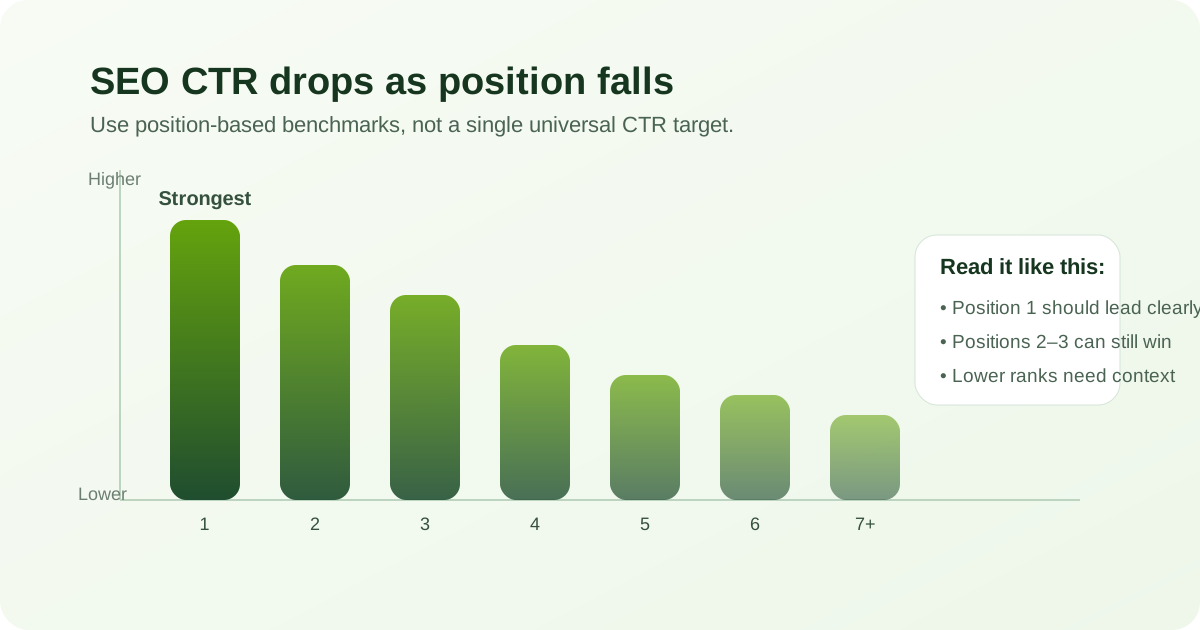
That means a 4% CTR can be disappointing at position 1 but perfectly healthy at position 7. Without the ranking context, the number tells you very little.
Why search intent changes CTR so much
Not all queries behave the same way. Informational searches often get spread across more results because users are exploring. Commercial and transactional searches usually concentrate more clicks near the top because the user wants the fastest credible answer.
For example:
- Informational query: "what is conversion rate optimisation" can produce more comparison clicks across several articles
- Commercial query: "seo consultant for saas" often rewards the few results that look immediately trustworthy and relevant
- Branded query: brand familiarity can drive exceptionally high CTR even if the title itself is average
This is also why pages built around clear search intent usually outperform pages that were written around keywords alone.
What a “bad” CTR usually means
Low CTR is a symptom, not a diagnosis. In practice, it usually points to one of five issues.
- The title is too generic. If your result sounds interchangeable with every other result, users have no reason to pick it.
- The page does not match intent. A general explainer ranking for a buyer-ready query will often underperform even with a decent title.
- The wrong page is ranking. This happens often when site architecture is messy and Google surfaces a blog post instead of a service page or vice versa.
- The SERP is crowded. AI Overviews, ads, snippets, local packs, video carousels, and People Also Ask can all reduce available clicks.
- Your result lacks a clear reason to click. Users need a quick signal that your page is more specific, fresher, clearer, or more credible than the alternatives.
That last point matters more than most people think. Good CTR is often just good positioning in plain English.
How to find CTR opportunities in Google Search Console
The fastest way to use CTR data properly is inside Google Search Console, filtered by page + query + average position.
Look for pages where:
- Impressions are high
- Average position is relatively strong
- CTR is lower than you would expect for that position
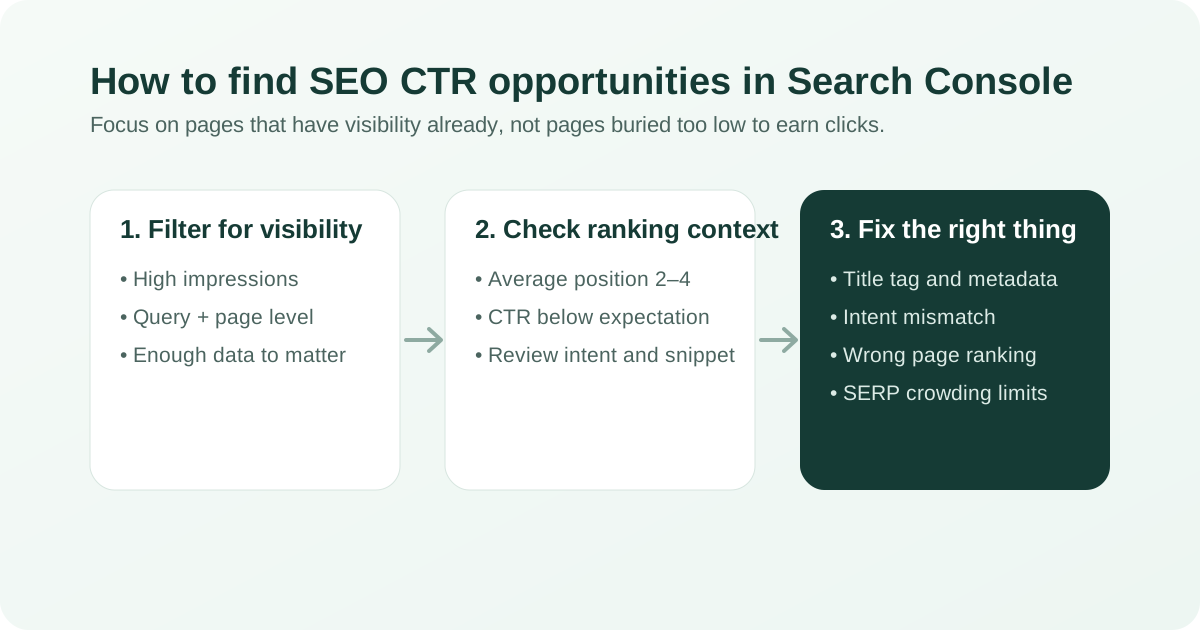
That combination usually means there is an opportunity. If a page is sitting around positions 2 to 4, getting a lot of impressions, and underperforming on clicks, it is worth reviewing the snippet and the intent match.
If the page ranks in positions 8 to 10, the bigger lever is often rank improvement rather than title rewriting. This is where many teams waste time polishing titles for pages that simply are not visible enough yet.
How to improve SEO CTR without sounding clickbait
The goal is not to write sensational titles. The goal is to make the result feel like the clearest and most useful answer on the page.
In practice, that usually means:
- Lead with the real topic: avoid vague titles that hide the payoff
- Add specificity: words like guide, benchmark, examples, pricing, checklist, and comparison can help when they reflect the actual content
- Match the query language: if users search "good CTR for SEO", your title should clearly answer that question
- Use fresh framing where relevant: years, updated guidance, or current context can improve relevance
- Write meta descriptions for humans: they do not directly improve ranking, but they can improve click appeal
The best-performing titles are usually the clearest ones, not the cleverest ones.
Title tag patterns that tend to work
There is no universal format, but these patterns are usually reliable when the page actually delivers on them:
- Question + answer: "What’s a Good Click-Through Rate (CTR) for SEO?"
- Topic + qualifier: "SEO CTR Benchmarks: What Counts as Good?"
- Topic + outcome: "How to Improve Organic CTR Without Chasing Clickbait"
- Topic + audience: "SEO CTR Benchmarks for SaaS and Service Websites"
The main thing to avoid is writing titles that promise something the page does not actually give. Short-term clicks are not worth long-term disappointment.
Why ranking position still matters more than title tweaks
A lot of CTR advice quietly ignores the obvious: moving from position 5 to position 2 will usually have a far bigger impact than any metadata rewrite. That does not mean titles do not matter. They do. But snippet optimisation works best when the page is already close enough to the top to compete for attention.
That is why CTR work should sit inside a broader SEO strategy, not replace it. If the page lacks authority, internal support, or intent alignment, CTR tweaks alone will not rescue it.
When high CTR can be misleading
High CTR is not automatically a win either. Sometimes a page attracts clicks because the title overpromises, but users bounce because the content does not satisfy the search. That is not sustainable. In those cases, CTR looks good while actual business value stays weak.
The better outcome is a page that earns clicks and satisfies the visit. For service businesses, I would much rather have slightly lower CTR with better lead quality than inflated clicks from curiosity traffic that never converts.
What to track alongside CTR
If you want SEO CTR to be useful, pair it with other signals:
- Average position: CTR without ranking context is incomplete
- Query intent: informational, commercial, navigational, or transactional
- Landing page engagement: does the page satisfy the click?
- Conversions or assisted conversions: are those clicks commercially useful?
- SERP layout: what else is taking attention above your result?
If your measurement setup is weak, fix that before over-interpreting SEO performance. The same logic applies in my guides to GA4 tracking and attribution: better decisions require cleaner context.
So, what’s a good CTR for SEO?
A good CTR is one that is strong for your ranking position and query type. That is the most honest answer.
If you rank near the top and your CTR is weak, you probably have a snippet, intent, or page-selection issue worth fixing. If you rank lower down the page, your main problem is often visibility, not copywriting. And if your CTR is strong but conversions are weak, you may be attracting the wrong clicks.
Use CTR as a diagnostic metric, not a vanity trophy. That is when it becomes genuinely useful.
If you want help finding high-impression, low-CTR pages that are worth fixing first, get in touch.
Get weekly growth ideas in your inbox
Practical SEO, PPC, analytics, and CRO notes with zero spam.
Frequently Asked Questions
What is a good CTR for SEO?▾
Is a 5% CTR good for SEO?▾
How do I improve organic CTR?▾
Does CTR affect SEO rankings?▾
What hurts SEO CTR the most?▾

Digital marketing consultant — SEO, PPC, analytics & CRO.