
Data Layer
A JavaScript object that standardises how data is passed from a website or app to analytics and marketing tools via Google Tag Manager. The site pushes events and variables — product IDs, user types, transaction values, page categories — to the data layer, and GTM listens and fires tags in response. A well-implemented data layer is the foundation of accurate, scalable, and developer-independent tracking.
How Data Layer works in practice
The most common data layer pattern uses a JavaScript array (window.dataLayer = window.dataLayer || []) that GTM listens to for push events. Each push typically includes an event name and associated parameters: window.dataLayer.push({event: "form_submit", form_name: "contact", user_type: "prospect"}). Without a data layer, GTM relies on CSS selectors and DOM scraping — brittle, maintenance-heavy, and prone to breaking when the site's HTML structure changes. Implementing a data layer specification document — a shared contract between marketing and development teams defining all events, parameters, and expected values — is the single most impactful step in creating a scalable, reliable tracking infrastructure.

Your digital consultant
Hi, I'm Wameq.
If your data looks fine but decisions still feel like guesses, your measurement setup needs work.
Let's talk →This term sits in the Analytics category, which means it is most useful when evaluating measurement design, attribution quality, reporting accuracy, and decision-making. The goal is not to memorize the label. The goal is to know when it should change a decision, a page, a campaign, or a measurement setup.
Related terms
A tag management system that lets you deploy and manage marketing and analytics tags on your site without editing code. GTM speeds up tracking implementation, reduces developer dependency, and centralises tracking governance.
Measuring specific user interactions on a website or app — clicks, form submissions, video plays, scroll depth, file downloads. In GA4, every user interaction is modelled as an event rather than a pageview.
Google's current analytics platform built on an event-based model, replacing the session-based Universal Analytics. GA4 integrates with Google Ads, supports cross-platform (web + app) tracking, and uses machine learning for predictive insights.
The process of measuring actions that matter to your business — purchases, leads, sign-ups — and sending that data to ad platforms to evaluate performance and power automated bidding strategies like Smart Bidding.
Put Data Layer to work
Understanding Data Layer is one thing — operationalising it across tracking, acquisition, and conversion is another. Explore the full range of digital marketing services, including SEO & content consulting, paid media management, and analytics & CRO. Or work directly with a digital marketing consultant in Dubai on building growth systems that actually compound.
Learn more: related articles
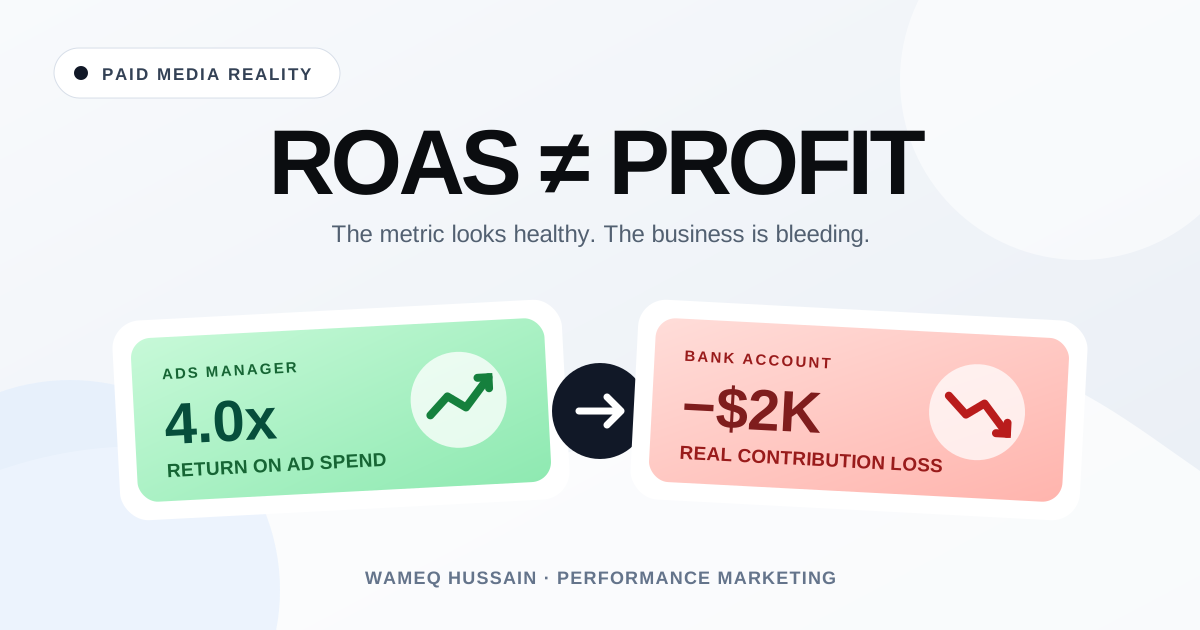
Why Your Ads Look Profitable but Your Business Is Still Losing Money
Your ads report healthy ROAS while margin keeps shrinking. See where the numbers split—and how to measure whether paid media actually makes money.
Crypto Exchange Marketing: The 2026 User Growth Playbook
The crypto user base is heading from roughly 600 million in 2026 toward 1.2 billion by 2035, but the channels that grew exchanges in the last cycle are throttled, expensive, or compliance-restricted. This is the full-funnel playbook for acquiring, activating, and retaining funded traders in 2026 — trust signals, AI-search visibility, paid acquisition across restricted channels, community loops, and measurement that survives an audit.
How to Measure PPC Performance When AI Controls the Auction
AI Max, Performance Max, and Smart Bidding have taken over the inputs that PPC teams used to control — keywords, bids, match types, placements. That means most of the metrics your dashboard still shows are describing a game that no longer exists. Here is the four-layer measurement stack that actually tells you whether a 2026 paid account is working: profitability, incrementality, blended CAC, and first-party data quality.