
Cookie Deprecation
The phased removal of third-party cookies from major browsers, which historically powered cross-site tracking, retargeting pools, and multi-touch attribution. Safari and Firefox blocked them years ago; Chrome’s staged rollout has reshaped measurement for every paid media team. The response stack is first-party data, server-side tagging, Privacy Sandbox APIs, clean rooms, and more aggressive use of modelled conversions.
How Cookie Deprecation works in practice
The end of third-party cookies has been the single biggest structural change to paid media measurement in a decade. Retargeting pools shrank because cross-site identifiers stopped propagating, attribution windows collapsed to what platforms could observe within their own walled garden, and modelled conversions began filling the gaps in reported data. The replacement stack has several layers: first-party data collection (logged-in users, CRM), server-side tagging to extend observation windows under first-party contexts, enhanced conversions to pass hashed PII to ad platforms for better match rates, Privacy Sandbox APIs for cohort-level targeting, and data clean rooms for measurement. Teams that over-relied on last-click reporting from ad platforms were most exposed; teams that had invested in server-side GTM, consent mode, and MMM-style measurement found the transition manageable.

Your digital consultant
Hi, I'm Wameq.
If your data looks fine but decisions still feel like guesses, your measurement setup needs work.
Let's talk →This term sits in the Analytics category, which means it is most useful when evaluating measurement design, attribution quality, reporting accuracy, and decision-making. The goal is not to memorize the label. The goal is to know when it should change a decision, a page, a campaign, or a measurement setup.
Related terms
Data a business collects directly from its own users, customers, and website visitors through forms, purchases, logins, product usage, and consented tracking. First-party data is increasingly important as third-party tracking becomes less reliable.
A CMP is the software layer that captures, stores, and signals user consent for tracking, advertising, and personalisation across GDPR, CCPA, and similar regimes. It controls which tags fire, how IDs are passed to downstream partners, and provides the audit trail regulators expect. A misconfigured CMP silently breaks conversion tracking and ad personalisation — it is usually the first thing to audit when reported conversions drop sharply.
A tracking setup where analytics and marketing data are routed through a server container before being sent to platforms. It improves control, data quality, and privacy compliance compared to purely browser-side tagging.
A feature in Google Ads that uses hashed first-party customer data to improve conversion measurement. It helps recover attribution lost because of browser restrictions and privacy changes.
Put Cookie Deprecation to work
Understanding Cookie Deprecation is one thing — operationalising it across tracking, acquisition, and conversion is another. Explore the full range of digital marketing services, including SEO & content consulting, paid media management, and analytics & CRO. Or work directly with a digital marketing consultant in Dubai on building growth systems that actually compound.
Learn more: related articles
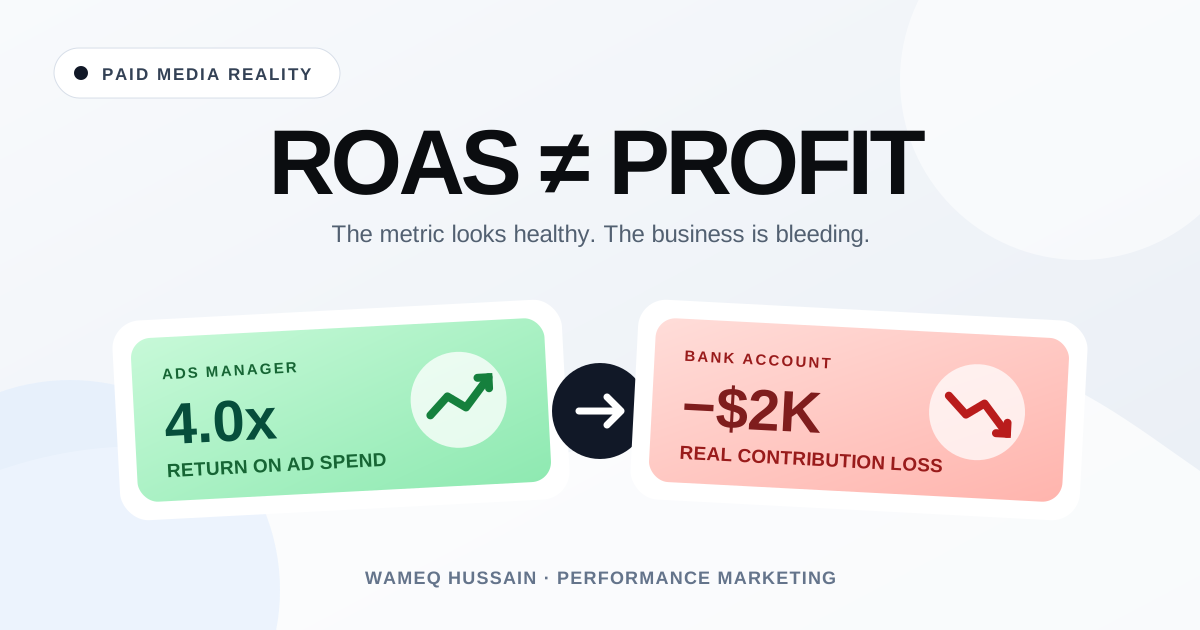
Why Your Ads Look Profitable but Your Business Is Still Losing Money
Your ads report healthy ROAS while margin keeps shrinking. See where the numbers split—and how to measure whether paid media actually makes money.

Crypto Exchange Marketing: The 2026 User Growth Playbook
The crypto user base is heading from roughly 600 million in 2026 toward 1.2 billion by 2035, but the channels that grew exchanges in the last cycle are throttled, expensive, or compliance-restricted. This is the full-funnel playbook for acquiring, activating, and retaining funded traders in 2026 — trust signals, AI-search visibility, paid acquisition across restricted channels, community loops, and measurement that survives an audit.
How to Measure PPC Performance When AI Controls the Auction
AI Max, Performance Max, and Smart Bidding have taken over the inputs that PPC teams used to control — keywords, bids, match types, placements. That means most of the metrics your dashboard still shows are describing a game that no longer exists. Here is the four-layer measurement stack that actually tells you whether a 2026 paid account is working: profitability, incrementality, blended CAC, and first-party data quality.