Conversion Path Length
Conversion path length measures how many touches, visits, or interactions usually happen before a conversion occurs. It helps marketers understand whether a journey is fast and direct or longer and more dependent on multiple channels.
How Conversion Path Length works in practice
Conversion Path Length matters most when teams are trying to make better decisions around measurement design, attribution quality, reporting accuracy, and decision-making. The short definition gives the surface meaning, but the practical value comes from knowing when this concept should actually influence strategy and when it should not.
In real-world work, Conversion Path Length is rarely important on its own. It usually becomes useful when paired with cleaner measurement, stronger page or funnel structure, and a clear understanding of what business outcome needs to improve. It is closely connected to Assisted Conversion, Attribution Window, Funnel Analysis because those concepts usually shape how Conversion Path Length is measured or applied in practice.
A good way to use Conversion Path Length is to treat it as a decision aid rather than a vanity number. If it helps explain why performance is improving, stalling, or getting more expensive, it is useful. If it is being tracked without any operational consequence, it is probably being overvalued.

Your digital consultant
Hi, I'm Wameq.
If your data looks fine but decisions still feel like guesses, your measurement setup needs work.
Let's talk →This term sits in the Analytics category, which means it is most useful when evaluating measurement design, attribution quality, reporting accuracy, and decision-making. The goal is not to memorize the label. The goal is to know when it should change a decision, a page, a campaign, or a measurement setup.
Related terms
An assisted conversion happens when a channel or page contributes to the path to conversion without being the final touchpoint. It is especially important for SEO, content, and upper-funnel campaigns that influence demand before a branded search, direct visit, or final click converts.
The period after an ad interaction during which a conversion can still be credited back to that touchpoint, such as 7-day click or 1-day view.
Mapping and measuring the sequential steps users take toward a conversion goal. Funnel analysis pinpoints where users drop off so optimisation effort is directed at the highest-impact bottlenecks.
Time to convert measures how long it typically takes a user to move from first touch or first visit to conversion. It is especially useful for understanding sales-cycle length, attribution windows, and remarketing timing.
Put Conversion Path Length to work
Understanding Conversion Path Length is one thing — operationalising it across tracking, acquisition, and conversion is another. Explore the full range of digital marketing services, including SEO & content consulting, paid media management, and analytics & CRO. Or work directly with a digital marketing consultant in Dubai on building growth systems that actually compound.
Learn more: related articles
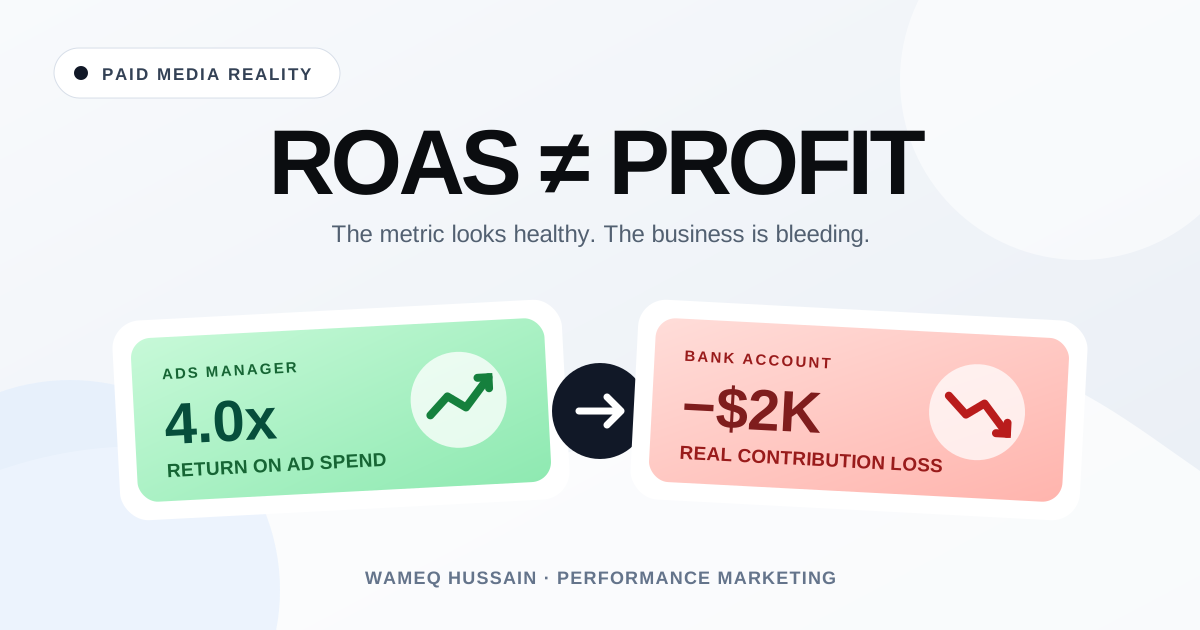
Why Your Ads Look Profitable but Your Business Is Still Losing Money
Your ads report healthy ROAS while margin keeps shrinking. See where the numbers split—and how to measure whether paid media actually makes money.
Crypto Exchange Marketing: The 2026 User Growth Playbook
The crypto user base is heading from roughly 600 million in 2026 toward 1.2 billion by 2035, but the channels that grew exchanges in the last cycle are throttled, expensive, or compliance-restricted. This is the full-funnel playbook for acquiring, activating, and retaining funded traders in 2026 — trust signals, AI-search visibility, paid acquisition across restricted channels, community loops, and measurement that survives an audit.
How to Measure PPC Performance When AI Controls the Auction
AI Max, Performance Max, and Smart Bidding have taken over the inputs that PPC teams used to control — keywords, bids, match types, placements. That means most of the metrics your dashboard still shows are describing a game that no longer exists. Here is the four-layer measurement stack that actually tells you whether a 2026 paid account is working: profitability, incrementality, blended CAC, and first-party data quality.