
Cohort Analysis
Grouping users by a shared characteristic at a specific point in time — typically acquisition date — and tracking their behaviour over subsequent periods to identify retention patterns and LTV by segment. Cohort analysis reveals whether retention is improving or degrading over time and which acquisition channels produce users with higher long-term engagement.
How Cohort Analysis works in practice
GA4's Retention report provides a basic cohort view showing N-day retention for users by acquisition week. More granular cohort analysis — tracking LTV, CAC payback, and channel-specific retention — typically requires exporting GA4 data to BigQuery and writing SQL queries or using a BI tool like Looker Studio. The most common actionable insight from cohort analysis is identifying the "natural churn cliff" — the session or day at which a large proportion of users drop off — which often corresponds to a specific friction point or expectation mismatch in the onboarding flow. Cohorts acquired during different product versions or marketing campaigns can be compared to evaluate the business impact of product and marketing changes over time.

Your digital consultant
Hi, I'm Wameq.
If your data looks fine but decisions still feel like guesses, your measurement setup needs work.
Let's talk →This term sits in the Analytics category, which means it is most useful when evaluating measurement design, attribution quality, reporting accuracy, and decision-making. The goal is not to memorize the label. The goal is to know when it should change a decision, a page, a campaign, or a measurement setup.
Related terms
The total revenue expected from a customer over their entire relationship with the business. The LTV:CAC ratio is a core health metric; a ratio above 3:1 generally indicates a sustainable growth model for subscription businesses.
The percentage of customers who cancel or do not renew within a given period. High churn erodes MRR growth and increases CAC payback period, making retention optimisation as important as acquisition for sustainable growth.
The percentage of users who are still active in an app 7 days after their initial install or sign-up. D7 retention is a leading indicator of product-market fit — apps with D7 retention above 20% typically sustain significantly stronger 30-day and 90-day retention. Comparing D7 by acquisition channel and cohort identifies which channels bring the most genuinely engaged users.
Mapping and measuring the sequential steps users take toward a conversion goal. Funnel analysis pinpoints where users drop off so optimisation effort is directed at the highest-impact bottlenecks.
Put Cohort Analysis to work
Understanding Cohort Analysis is one thing — operationalising it across tracking, acquisition, and conversion is another. Explore the full range of digital marketing services, including SEO & content consulting, paid media management, and analytics & CRO. Or work directly with a digital marketing consultant in Dubai on building growth systems that actually compound.
Learn more: related articles
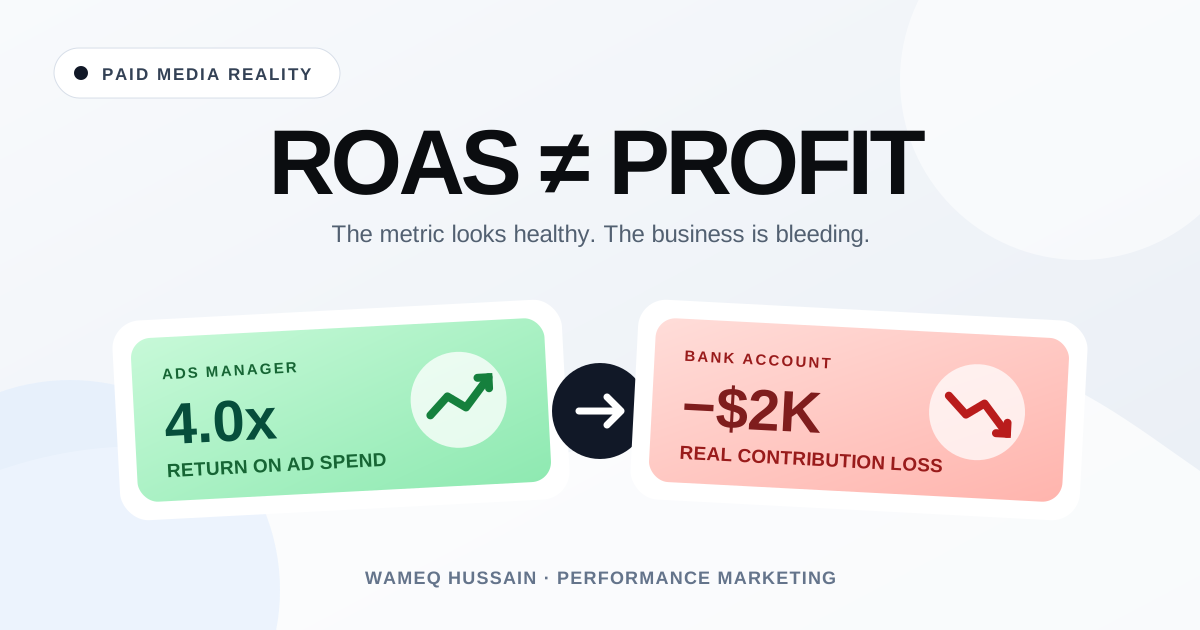
Why Your Ads Look Profitable but Your Business Is Still Losing Money
Your ads report healthy ROAS while margin keeps shrinking. See where the numbers split—and how to measure whether paid media actually makes money.

Crypto Exchange Marketing: The 2026 User Growth Playbook
The crypto user base is heading from roughly 600 million in 2026 toward 1.2 billion by 2035, but the channels that grew exchanges in the last cycle are throttled, expensive, or compliance-restricted. This is the full-funnel playbook for acquiring, activating, and retaining funded traders in 2026 — trust signals, AI-search visibility, paid acquisition across restricted channels, community loops, and measurement that survives an audit.
How to Measure PPC Performance When AI Controls the Auction
AI Max, Performance Max, and Smart Bidding have taken over the inputs that PPC teams used to control — keywords, bids, match types, placements. That means most of the metrics your dashboard still shows are describing a game that no longer exists. Here is the four-layer measurement stack that actually tells you whether a 2026 paid account is working: profitability, incrementality, blended CAC, and first-party data quality.