
Trust Badges
Visual trust signals such as security icons, guarantees, certifications, or compliance claims. They reduce hesitation when placed near forms, pricing, or checkout steps.
How Trust Badges works in practice
Trust Badges matters most when teams are trying to make better decisions around landing page clarity, conversion friction, trust, and user decision-making. The short definition gives the surface meaning, but the practical value comes from knowing when this concept should actually influence strategy and when it should not.
In real-world work, Trust Badges is rarely important on its own. It usually becomes useful when paired with cleaner measurement, stronger page or funnel structure, and a clear understanding of what business outcome needs to improve. It is closely connected to Checkout Abandonment, Conversion Rate, Social Proof because those concepts usually shape how Trust Badges is measured or applied in practice.
A good way to use Trust Badges is to treat it as a decision aid rather than a vanity number. If it helps explain why performance is improving, stalling, or getting more expensive, it is useful. If it is being tracked without any operational consequence, it is probably being overvalued.

Your digital consultant
Hi, I'm Wameq.
If traffic is coming in but conversions aren't, the page is doing something wrong — I can tell you what.
Let's talk →This term sits in the CRO category, which means it is most useful when evaluating landing page clarity, conversion friction, trust, and user decision-making. The goal is not to memorize the label. The goal is to know when it should change a decision, a page, a campaign, or a measurement setup.
Related terms
The rate at which users begin a checkout flow but fail to complete purchase. Common causes include unexpected costs, slow forms, weak trust, or payment friction.
The percentage of visitors or users who complete a desired action. Conversion Rate = (Conversions / Total Visitors) × 100. Even small improvements in conversion rate compound significantly on paid media budgets.
Testimonials, reviews, case studies, client logos, or usage statistics that reassure prospects by showing others have trusted and benefited from your product or service. Social proof is a primary reducer of conversion friction.
Put Trust Badges to work
Understanding Trust Badges is one thing — operationalising it across tracking, acquisition, and conversion is another. Explore the full range of digital marketing services, including SEO & content consulting, paid media management, and analytics & CRO. Or work directly with a digital marketing consultant in Dubai on building growth systems that actually compound.
Learn more: related articles
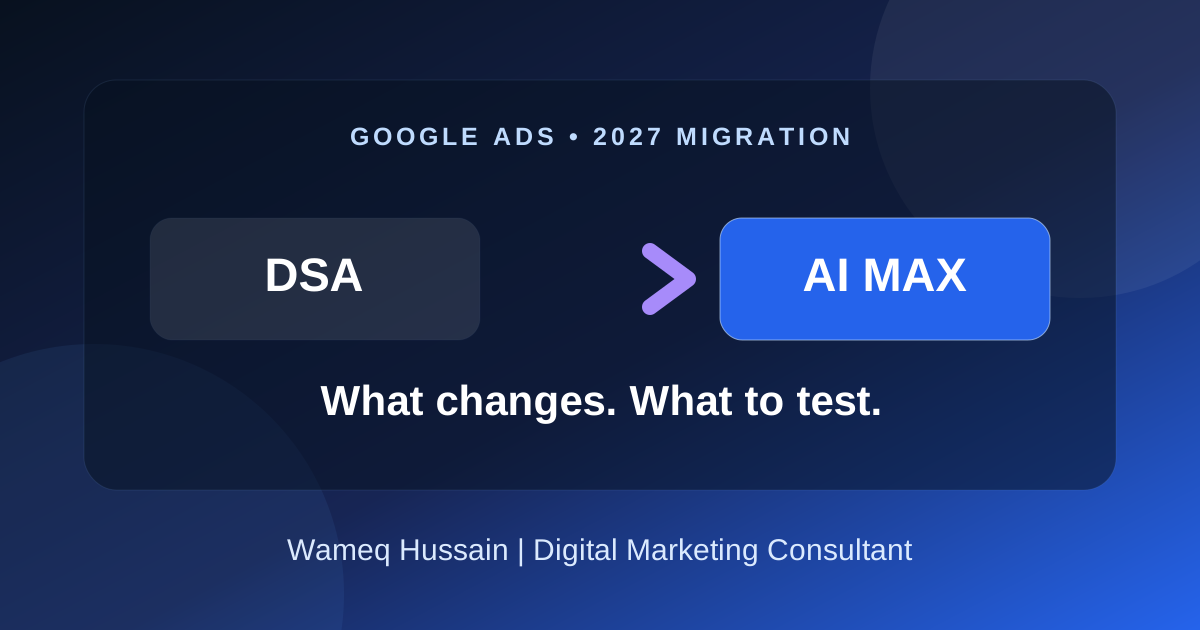
Google Dynamic Search Ads Are Going Away: How to Prepare for AI Max
Google is moving Dynamic Search Ads into AI Max from February 2027. Here is what changes and how to test the migration without giving up control.
Crypto Exchange Marketing: The 2026 User Growth Playbook
The crypto user base is heading from roughly 600 million in 2026 toward 1.2 billion by 2035, but the channels that grew exchanges in the last cycle are throttled, expensive, or compliance-restricted. This is the full-funnel playbook for acquiring, activating, and retaining funded traders in 2026 — trust signals, AI-search visibility, paid acquisition across restricted channels, community loops, and measurement that survives an audit.
How User Behaviour Tells You to Improve Your Website
Most conversion problems are not traffic problems. The fix is on the page. User behaviour data — scroll depth, heatmaps, rage clicks, session recordings and form drop-offs — shows you exactly where visitors are losing interest and why. This is how CRO actually works in practice.