
Product-Market Fit
The degree to which a product satisfies strong market demand. A product with genuine PMF retains users without heavy intervention, generates organic referrals, and sees sustainable growth without disproportionate acquisition spend. Sean Ellis's benchmark — 40% of users saying they would be "very disappointed" if the product disappeared — is a widely used proxy test.
How Product-Market Fit works in practice
Product-Market Fit matters most when teams are trying to make better decisions around growth strategy, funnel performance, and customer acquisition economics. The short definition gives the surface meaning, but the practical value comes from knowing when this concept should actually influence strategy and when it should not.
In real-world work, Product-Market Fit is rarely important on its own. It usually becomes useful when paired with cleaner measurement, stronger page or funnel structure, and a clear understanding of what business outcome needs to improve. It is closely connected to North Star Metric, Churn Rate, Net Promoter Score because those concepts usually shape how Product-Market Fit is measured or applied in practice.
A good way to use Product-Market Fit is to treat it as a decision aid rather than a vanity number. If it helps explain why performance is improving, stalling, or getting more expensive, it is useful. If it is being tracked without any operational consequence, it is probably being overvalued.

Your digital consultant
Hi, I'm Wameq.
If growth feels slower than it should, the gap is usually in measurement, acquisition, or conversion — I cover all three.
Let's talk →This term sits in the General category, which means it is most useful when evaluating growth strategy, funnel performance, and customer acquisition economics. The goal is not to memorize the label. The goal is to know when it should change a decision, a page, a campaign, or a measurement setup.
Related terms
The single metric a business treats as its clearest indicator of sustainable value creation.
The percentage of customers who cancel or do not renew within a given period. High churn erodes MRR growth and increases CAC payback period, making retention optimisation as important as acquisition for sustainable growth.
A measure of customer loyalty calculated by asking users how likely they are to recommend the product on a 0 to 10 scale. Respondents are grouped into Promoters (9–10), Passives (7–8), and Detractors (0–6). NPS = % Promoters minus % Detractors. It is a leading indicator of retention, expansion revenue, and word-of-mouth growth.
A self-reinforcing system where one user action helps generate more acquisition, activation, or retention.
Put Product-Market Fit to work
Understanding Product-Market Fit is one thing — operationalising it across tracking, acquisition, and conversion is another. Explore the full range of digital marketing services, including SEO & content consulting, paid media management, and analytics & CRO. Or work directly with a digital marketing consultant in Dubai on building growth systems that actually compound.
Learn more: related articles
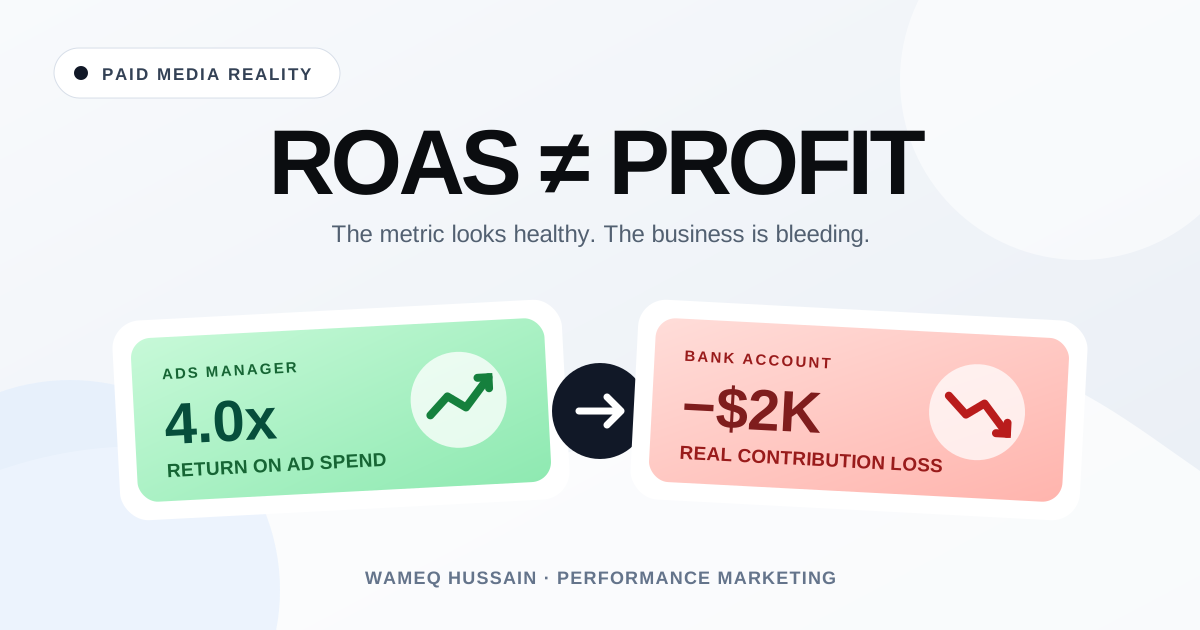
Why Your Ads Look Profitable but Your Business Is Still Losing Money
Your ads report healthy ROAS while margin keeps shrinking. See where the numbers split—and how to measure whether paid media actually makes money.

Crypto Advertising Compliance in 2026: Licences, Certifications and Ad Platform Rules by Region
Crypto is now the most heavily gated advertising category on the internet, and the gate has two locks: the licence your financial regulator issues, and the certification each ad platform grants on proof of it — country by country. This is the full 2026 reference: every region Google will certify and the exact licence it demands, what stays banned regardless of licence, the marketing rules VARA, MiCA, the FCA and MAS impose on your creative, and what to do in the markets where paid media is simply closed.

Google Dynamic Search Ads Are Going Away: How to Prepare for AI Max
Google is moving Dynamic Search Ads into AI Max from February 2027. Here is what changes and how to test the migration without giving up control.