
Media Mix Modeling
Media Mix Modeling (MMM)
A statistical, top-down approach that estimates each channel’s contribution to outcomes using aggregate spend and results over time, without user-level tracking. Privacy loss and AI-controlled auctions have revived MMM as a privacy-durable counterweight to click-based attribution.
How Media Mix Modeling works in practice
Media mix modeling estimates each channel’s contribution to business outcomes from aggregate spend and results over time, using statistical modeling rather than user-level tracking. Largely sidelined during the deterministic click-tracking era, MMM has returned to relevance precisely because privacy loss, signal degradation, and AI-controlled auctions have made user-level attribution both less accurate and less actionable. Its strengths are that it is privacy-durable, captures channels that resist click attribution such as brand, offline, and upper funnel, and provides a top-down counterweight to the bottom-up story platforms tell about themselves. Its limitations — data hunger, slower cadence, and sensitivity to specification — mean it works best triangulated with incrementality experiments rather than treated as a single source of truth.

Your digital consultant
Hi, I'm Wameq.
If your data looks fine but decisions still feel like guesses, your measurement setup needs work.
Let's talk →This term sits in the Analytics category, which means it is most useful when evaluating measurement design, attribution quality, reporting accuracy, and decision-making. The goal is not to memorize the label. The goal is to know when it should change a decision, a page, a campaign, or a measurement setup.
Related terms
A controlled experiment measuring the true causal impact of a marketing channel by comparing a test group exposed to the campaign against a holdout group that is not. Incrementality testing answers "how much revenue would we have generated without this channel?" — a question attribution models estimate but cannot definitively answer. Holdout tests are offered natively by Meta (Conversion Lift) and Google (Geo Experiments).
The rule that determines how credit for a conversion is assigned to different marketing touchpoints in the user journey. Choosing the right model affects how you allocate budget across channels and evaluate channel ROI.
The total customer acquisition cost calculated across all channels combined — total marketing and sales spend divided by total new customers in a period. Blended CAC differs from channel-specific CAC because it includes organic, referral, and word-of-mouth alongside paid channels. Companies with strong organic and community growth will have a blended CAC significantly below their paid-only CAC.
Put Media Mix Modeling to work
Understanding Media Mix Modeling is one thing — operationalising it across tracking, acquisition, and conversion is another. Explore the full range of digital marketing services, including SEO & content consulting, paid media management, and analytics & CRO. Or work directly with a digital marketing consultant in Dubai on building growth systems that actually compound.
Learn more: related articles
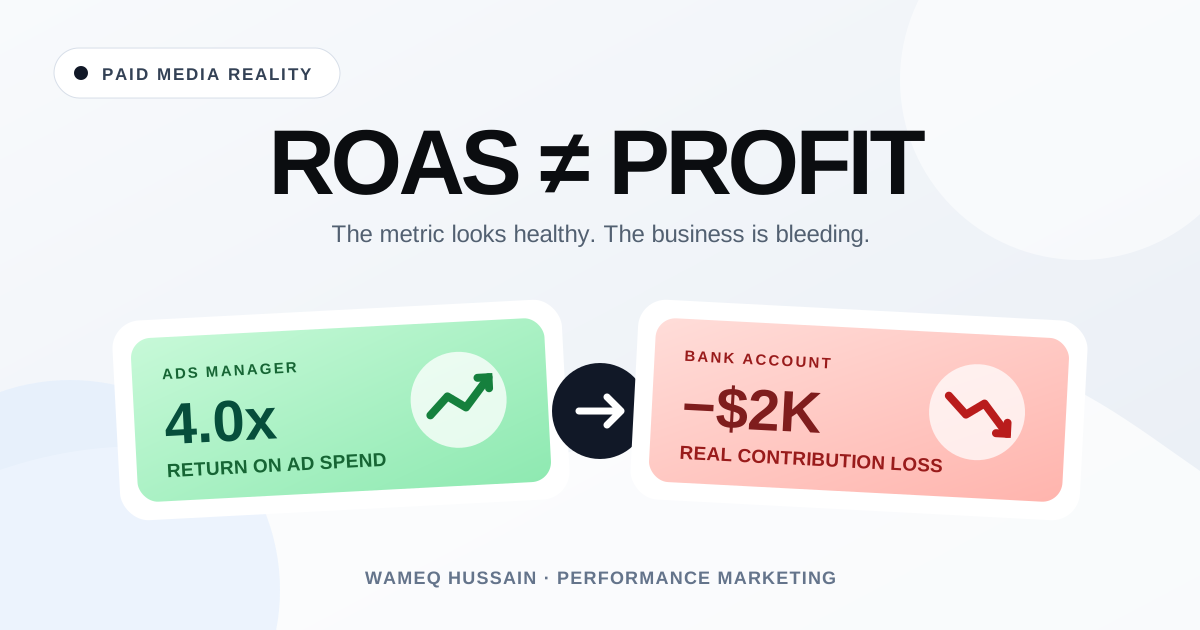
Why Your Ads Look Profitable but Your Business Is Still Losing Money
Your ads report healthy ROAS while margin keeps shrinking. See where the numbers split—and how to measure whether paid media actually makes money.

Crypto Exchange Marketing: The 2026 User Growth Playbook
The crypto user base is heading from roughly 600 million in 2026 toward 1.2 billion by 2035, but the channels that grew exchanges in the last cycle are throttled, expensive, or compliance-restricted. This is the full-funnel playbook for acquiring, activating, and retaining funded traders in 2026 — trust signals, AI-search visibility, paid acquisition across restricted channels, community loops, and measurement that survives an audit.
How to Measure PPC Performance When AI Controls the Auction
AI Max, Performance Max, and Smart Bidding have taken over the inputs that PPC teams used to control — keywords, bids, match types, placements. That means most of the metrics your dashboard still shows are describing a game that no longer exists. Here is the four-layer measurement stack that actually tells you whether a 2026 paid account is working: profitability, incrementality, blended CAC, and first-party data quality.