
Centralized Exchange
Centralized Exchange (CEX)
A crypto exchange operated by a company that manages custody, order books, and user accounts. CEX funnels are often measured with signup, KYC completion, deposit, and funded-account metrics.
How Centralized Exchange works in practice
Centralized Exchange matters most when teams are trying to make better decisions around on-chain activation, token behavior, protocol growth, and community participation. The short definition gives the surface meaning, but the practical value comes from knowing when this concept should actually influence strategy and when it should not.
In real-world work, Centralized Exchange is rarely important on its own. It usually becomes useful when paired with cleaner measurement, stronger page or funnel structure, and a clear understanding of what business outcome needs to improve. It is closely connected to Decentralized Exchange, Qualified Depositor, Cost Per Funded Account because those concepts usually shape how Centralized Exchange is measured or applied in practice.
A good way to use Centralized Exchange is to treat it as a decision aid rather than a vanity number. If it helps explain why performance is improving, stalling, or getting more expensive, it is useful. If it is being tracked without any operational consequence, it is probably being overvalued.

Your digital consultant
Hi, I'm Wameq.
If your protocol has users but not engagement, growth strategy is what's missing.
Let's talk →This term sits in the Crypto & Fintech category, which means it is most useful when evaluating on-chain activation, token behavior, protocol growth, and community participation. The goal is not to memorize the label. The goal is to know when it should change a decision, a page, a campaign, or a measurement setup.
Related terms
A crypto exchange that allows peer-to-peer trading through smart contracts instead of a central intermediary. DEX growth often depends on liquidity, wallet activation, and on-chain trust.
A user who not only signs up but deposits a meaningful amount or meets quality thresholds defined by the business. It is a better indicator of real acquisition value in financial products.
The acquisition cost required to bring in one account that completes an actual deposit or funds a wallet. This metric is often more meaningful than simple signup cost in fintech and crypto.
Put Centralized Exchange to work
Understanding Centralized Exchange is one thing — operationalising it across tracking, acquisition, and conversion is another. Explore the full range of digital marketing services, including SEO & content consulting, paid media management, and analytics & CRO. Or work directly with a digital marketing consultant in Dubai on building growth systems that actually compound.
Learn more: related articles

Crypto Advertising Compliance in 2026: Licences, Certifications and Ad Platform Rules by Region
Crypto is now the most heavily gated advertising category on the internet, and the gate has two locks: the licence your financial regulator issues, and the certification each ad platform grants on proof of it — country by country. This is the full 2026 reference: every region Google will certify and the exact licence it demands, what stays banned regardless of licence, the marketing rules VARA, MiCA, the FCA and MAS impose on your creative, and what to do in the markets where paid media is simply closed.
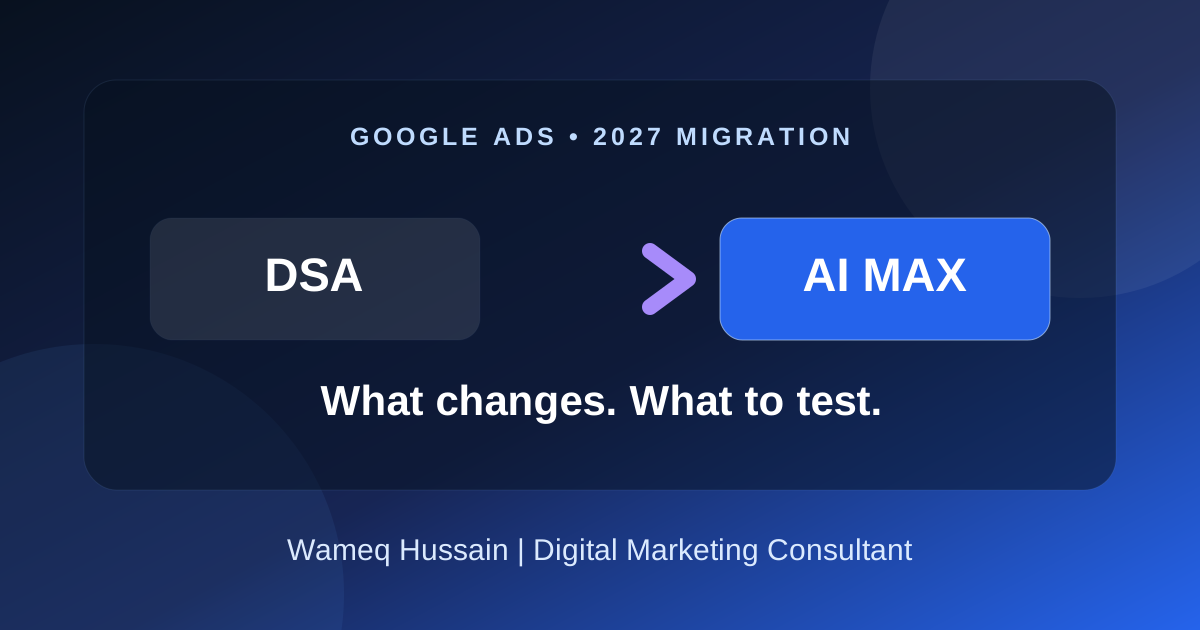
Google Dynamic Search Ads Are Going Away: How to Prepare for AI Max
Google is moving Dynamic Search Ads into AI Max from February 2027. Here is what changes and how to test the migration without giving up control.

Crypto Exchange Marketing: The 2026 User Growth Playbook
The crypto user base is heading from roughly 600 million in 2026 toward 1.2 billion by 2035, but the channels that grew exchanges in the last cycle are throttled, expensive, or compliance-restricted. This is the full-funnel playbook for acquiring, activating, and retaining funded traders in 2026 — trust signals, AI-search visibility, paid acquisition across restricted channels, community loops, and measurement that survives an audit.